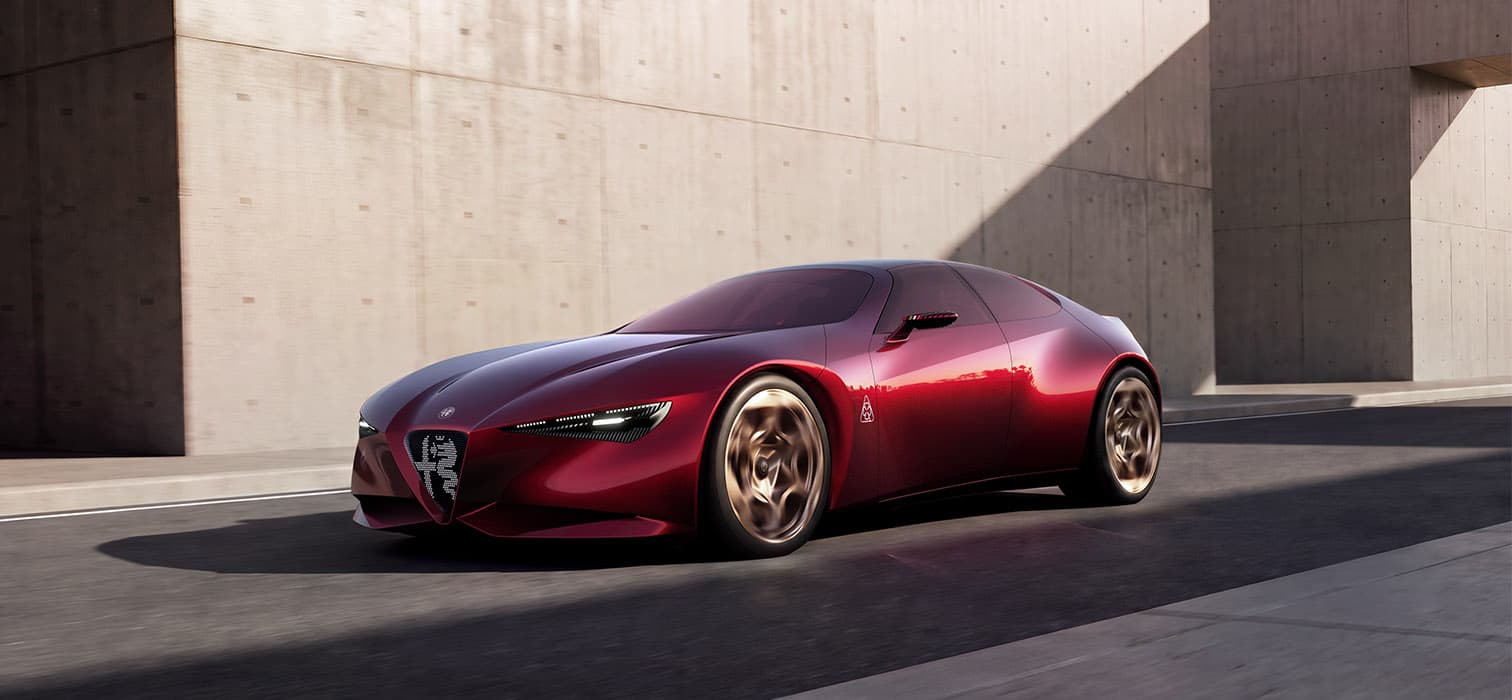

Monterey Car Week 2026 brought together the world’s most exclusive new cars, from Bugatti and Ferrari to Lamborghini, Porsche and Cadillac.
Pebble Beach Concours d’Elegance, where some of the most beautiful and valuable automobiles ever created compete for prestigious titles, is one of the highlights of Monterey Car Week. Another is “The Quail,” an event where numerous automotive brands stage the premieres of their latest models. As in previous years, some extraordinary new cars made their first public appearances at this ultra-exclusive gathering in 2026. Here are the most important new releases from Monterey Car Week 2026.
Contents
Acura Nexera Vision Concept: Headlights That Disappear
Acura, Honda’s luxury brand focused on the North American market, showcased its 40-year spirit of challenging convention alongside a vision of its future design language with the Nexera Vision Concept unveiled in Monterey. A high-performance sports coupe complete with upward-opening “butterfly doors” and lightweight carbon-ceramic details befitting a show car, the Nexera Vision Concept became the first vehicle to showcase Acura’s new “phantom lighting” signature.
This innovative lighting technology pioneered by the Nexera Vision Concept will make its way into series production with the fourth-generation Acura RDX Hybrid. When the lights are switched off, there is no visible trace of conventional headlights or taillights, allowing the sculptural, flowing and uninterrupted surfaces of the body to remain completely intact.

Aston Martin Valen: The Most Powerful Front-Engined Production Car Yet
With an 850-horsepower twin-turbocharged V12 beneath its bonnet, Aston Martin’s new Valen not only earns the title of “the most powerful front-engined production car” in the brand’s 112-year history, but also claims the distinction across the automotive industry as a whole.
Limited to just 150 examples, the Valen takes pure driving passion to another level with aggressive transmission calibration and aerodynamic details derived from the Vantage GT4 racing programme.

Brabus Bodo Cabriolet: 77 Examples in Tribute to Its Founder
Having recently attracted attention for introducing original automobiles rather than simply modified Mercedes-Benz models, Brabus followed the Bodo Coupe—created in memory of company founder Bodo Buschmann—with the Bodo Cabriolet at Monterey. Production has been limited to 77 examples as a reference to 1977, the year Brabus was founded.

This open-top masterpiece, constructed entirely from carbon fibre and featuring a 2+2 seating layout, combines the thrill of open-air driving with extreme performance. Its 5.2-litre twin-turbocharged V12 produces 1,000 horsepower and 1,200 Nm of torque. The 0–100 km/h sprint takes just 3 seconds, while top speed is electronically limited to 360 km/h.
Judging by the figures alone, the Brabus Bodo Cabriolet is clearly aiming for a place among the fastest and most powerful open-top grand tourers in the world.

Bugatti Destrier: A Hypercar Inspired by Medieval Armour
Bugatti unveiled the Destrier at Monterey 2026 as the latest creation from its bespoke “Programme Solitaire.” Built around the carbon-fibre monocoque platform of the track-focused Bolide, the Destrier takes its name from the powerful warhorses ridden by medieval knights.
Once again (!) promoted as “the Bugatti to use the final W16 engine,” the Destrier remains close to the brand’s other models with approximately 1,600 horsepower.

A specially laser-engraved plaque is integrated into the windscreen, itself shaped to recall the visor of a helmet, with silhouettes of the legendary Type 57G and Type 57SC Atlantic appearing in this section. A multi-layer exterior finish called Sapphire Celeste covers the body, contrasted by tinted exposed carbon-fibre surfaces on the front spoiler and rear diffuser. Decorative elements inspired by medieval armour also appear in the engine compartment and certain areas of the cabin, reinforcing the meaning behind the Destrier name.
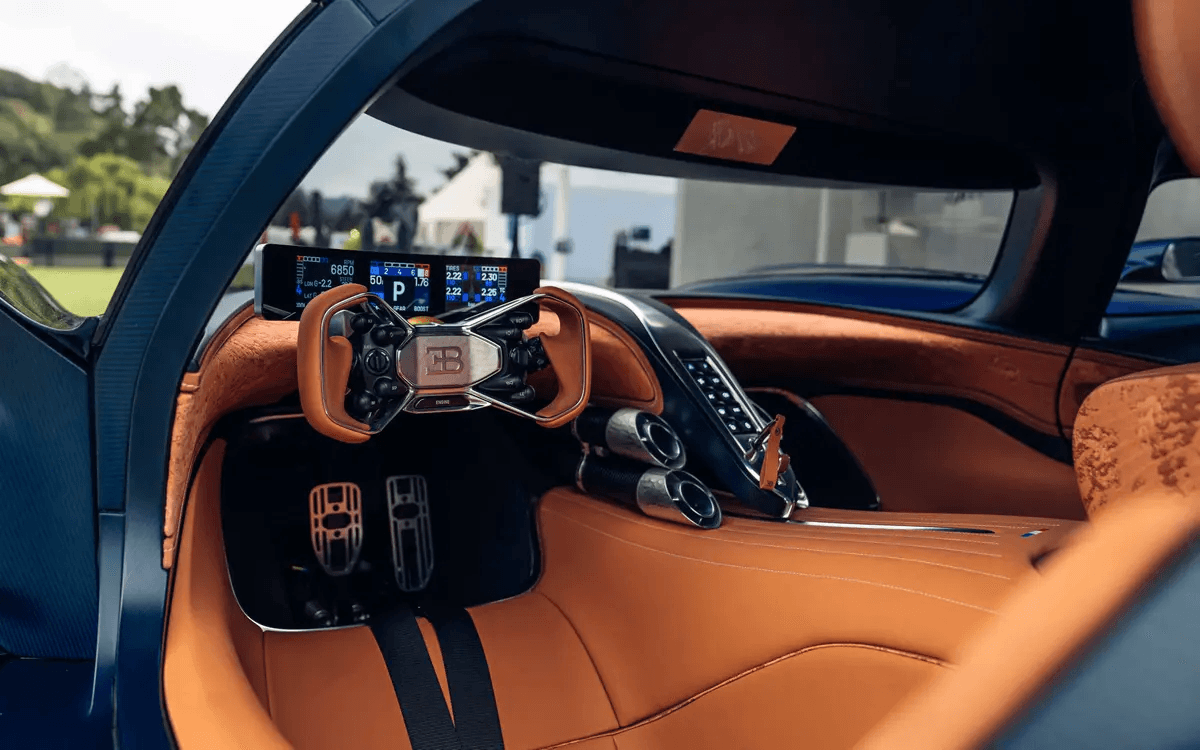
Moving away from the pure racing cockpit of the Bolide, the interior resembles a luxurious haute couture atelier, bringing together Ambre Voyageur brown leather, nubuck and bespoke 3D-knitted fabrics woven with fine copper threads.

Cadillac V-One Concept: Bringing Racing DNA to the Road
Having returned to both Le Mans and Formula 1 after many years away, Cadillac introduced the V-One Concept as a way of carrying its renewed motorsport involvement onto the road.
Translating the pure racing DNA of Cadillac’s V-Series.R LMDh racer—seen in the IMSA and WEC championships—into a road-going format, this single-seat show car features an 830-horsepower V8 hybrid powertrain. Depending on the reaction it receives, there is even a possibility that the concept could eventually enter production.

Developed in collaboration with Dallara, one of motorsport’s most established engineering companies, the Cadillac V-One Concept borrows systems directly from the race car, including its double-wishbone pushrod suspension and 830-horsepower V8 hybrid powertrain.
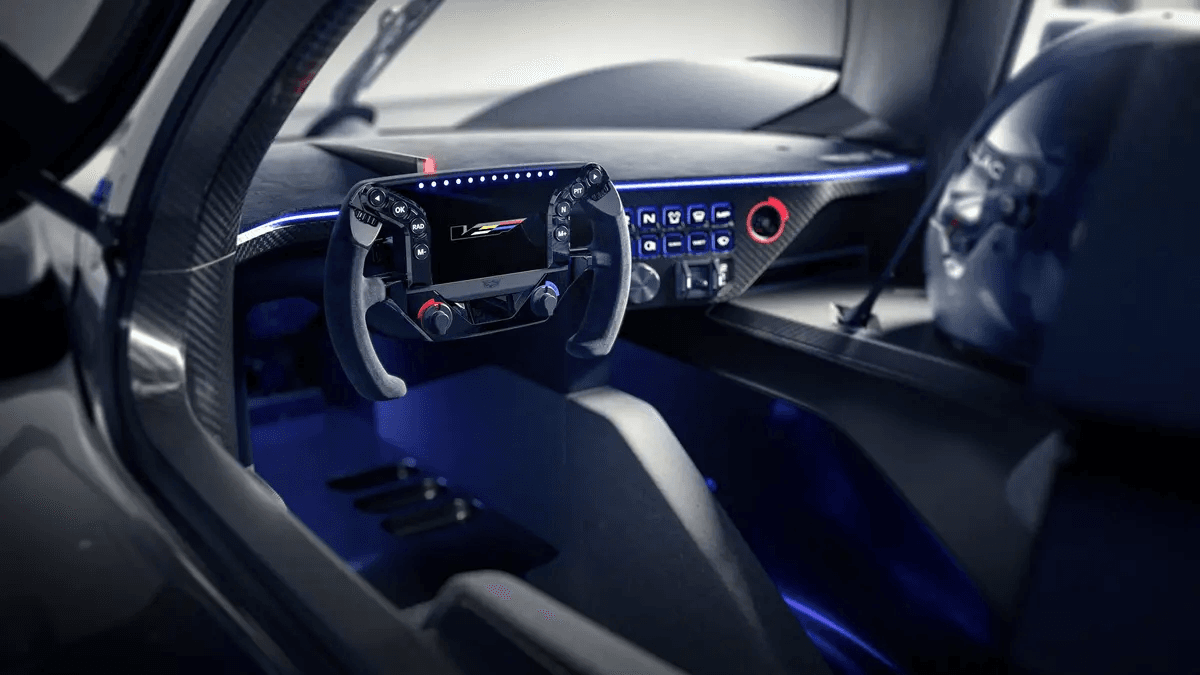
Inside the minimalist single-seat cockpit, Cadillac Collection recycled fabrics are joined by a seat moulded specifically for the driver, bespoke steering-wheel controls developed together with racing engineers and a numbered plaque mounted on the door, further emphasizing the car’s exclusivity.
Czinger 21C Spyder: The Bionic Hypercar Goes Roofless
California-based Czinger’s groundbreaking bio-engineering philosophy and 3D laser-printing technology meet an open-top roadster format for the first time in the new 21C Spyder.
Its rear-mid-mounted 2.88-litre twin-turbo V8, capable of revving to 11,000 rpm, works together with three electric motors to produce a combined 1,250 horsepower. The Czinger 21C Spyder enters the hyper-hybrid arena with prices starting at $2.75 million.

Limited to just 30 examples, the Czinger 21C Spyder can generate an enormous 1,500 kg of downforce even in open-top configuration with its removable carbon-fibre roof.
Brake calipers, suspension towers and hydraulic fluid channels developed using the brand’s AI-assisted design calculations and 3D metal-printing technology are combined into a single lightweight structure called BrakeNode. Compared with a conventional construction, the system delivers significant improvements in weight distribution and can reduce braking distances by as much as 15 per cent.

The jet-fighter-style tandem seating arrangement is retained, with the driver positioned front and centre and the passenger seated directly behind. Inside the cockpit, the NeuralNode control centre eliminates the clutter of touchscreens by integrating controls into 3D-printed metal components, while dedicated climate-control and ventilation channels have been optimized specifically for open-top comfort.
All of this effort ultimately creates a spectacular toy capable of accelerating from 0 to 96 km/h in just 1.9 seconds.

Ferrari CZ26: Maranello’s Latest One-Off
Not wanting to miss out on the excitement surrounding Monterey 2026, Ferrari unveiled the CZ26, the latest addition to its series of automobiles produced as single examples.
Derived from the SF90 Stradale platform for an unnamed private American collector, the Ferrari CZ26 was created by the Ferrari Design Studio under Flavio Manzoni. Abandoning the soft, flowing surfaces of the SF90, the design reinterprets the sharp, horizontal silhouette of the Ferrari 512 BB “Berlinetta” through a modern aerodynamic architecture inspired by 1970s industrial design and the Brutalist movement.

Its 1,000-horsepower plug-in hybrid system combines a 4.0-litre twin-turbocharged V8 with three electric motors. The model completes the 0–100 km/h sprint in 2.5 seconds, while its 7.9 kWh battery also provides an all-electric driving range of 25 kilometres.

The body is finished in glossy Argento Veloce silver, while Rosso Lampante red details and black technical-fabric upholstery in the cabin recreate one of the cult colour combinations of the 1970s.
Bespoke 3D-printed seat inserts, metallic filaments integrated into carbon-fibre surfaces and specially machined CZ26 logos throughout the cabin further reinforce the car’s highly personalized identity.

GMSV S1: Gordon Murray Reimagines the McLaren F1 Formula
Officially announced by the Gordon Murray Special Vehicles (GMSV) team during Monterey 2026, the new S1 leaves behind the uncompromising track-focused character of the S1 LM in favour of a machine designed around driving on real roads.
Gordon Murray, the chief engineer behind the McLaren F1, once again focuses on an analogue experience with the GMSV S1, reinterpreting the lines and philosophy of the legendary hypercar in an entirely different way.

Directly behind its three-seat cockpit, where the driver occupies the central position, sits a Cosworth-developed naturally aspirated 4.2-litre V12. Delivering 80 per cent of its maximum torque from just 2,500 rpm, this mechanical work of art produces approximately 690 horsepower.
Power is sent to the rear wheels through a close-ratio six-speed manual transmission.

Weighing approximately 997 kg, only 64 examples of this extraordinary piece of engineering will be produced—and every one of them had already been sold before Monterey 2026 began.
Hennessey Blackbird: A Hyper-GT Inspired by the SR-71
Still determined to remain a contender in the race to build the world’s fastest production automobile, Hennessey Special Vehicles created the Blackbird for Monterey 2026.
Unlike the Venom, which once pursued outright speed records, this ultra-exclusive Hyper-GT focuses entirely on pure driving sensation and analogue connection. Inspired by the legendary Lockheed SR-71 Blackbird reconnaissance aircraft, it has been developed as a machine ready to take that philosophy onto the road.

Challenging the increasingly digitalized, hybridized and complex architecture of today’s performance cars, the Blackbird combines a naturally aspirated 6.2-litre V8 developed in partnership with Ilmor Engineering—capable of revving to 9,000 rpm—with a six-speed manual transmission. A completely screen-free cockpit further reinforces the concept.
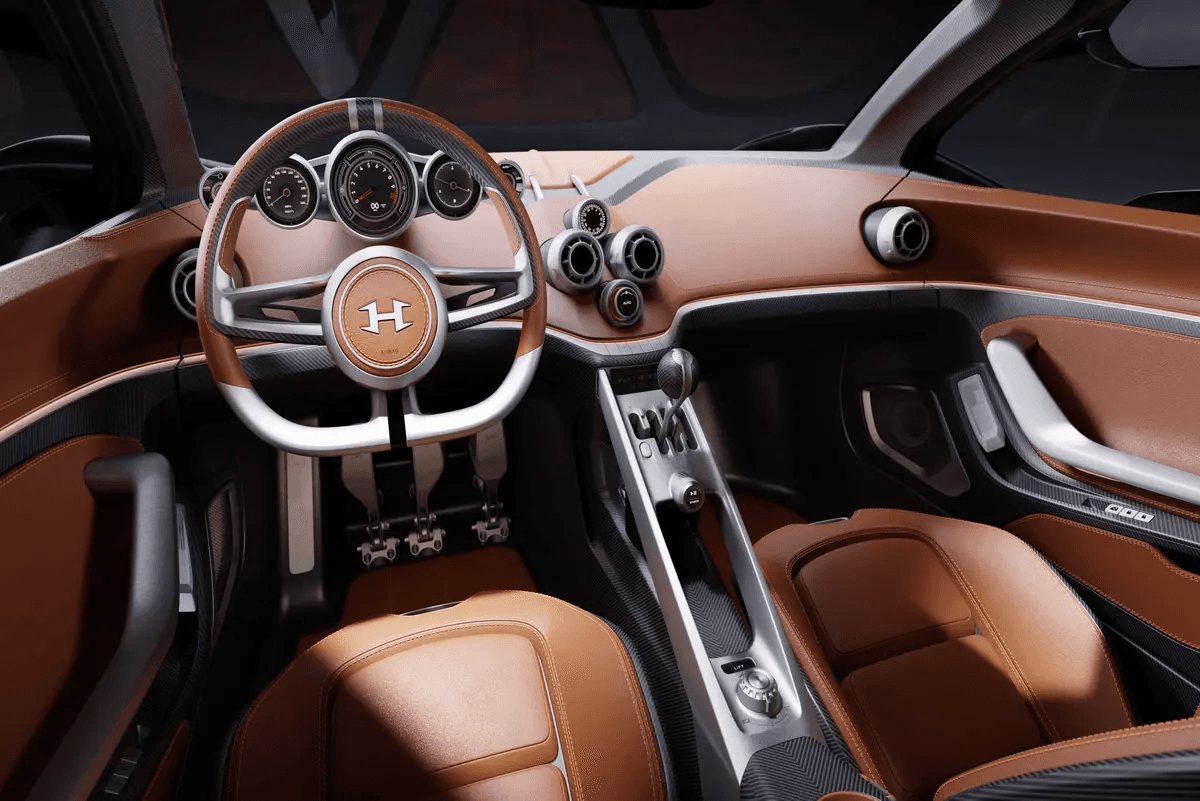
With a claimed 0–100 km/h time of 2.5 seconds and a top speed of 354 km/h, the Hennessey Blackbird produces approximately 850 horsepower.
In another reference to the aircraft that gives the car its name, movable vertical rear stabilizers automatically deploy at 71 mph and position themselves at an angle of 71 degrees, serving both as a distinctive visual signature and as functional aerodynamic elements.

The number 71 also determines the production limit. Priced from $2.5 million, the Hennessey Blackbird had already received 60 orders before Monterey 2026. The remaining 11 cars sold out within four hours of its debut at the event.
Koenigsegg CCGT1: When the Ghost Becomes the Body
The CCGT1, Koenigsegg’s latest creation and a model limited to just 70 examples, had already sold out before making its official debut at Monterey 2026.
The CCGT1 is an official tribute, 12 years later, to the legendary CCGT racing project developed by the brand for the FIA GT1 category in the mid-2000s but shelved before it could ever reach the track due to sudden changes in class regulations.

The ghost logos used on every model built after the fire that destroyed the company’s original production facility—a reference to the spirits of the cars lost in that first factory—have been interpreted in an entirely different manner this time.
Based on the Koenigsegg CC850 architecture, the CCGT1 combines a carbon-fibre monocoque body with a 5.0-litre twin-turbocharged V8 capable of producing 1,600 horsepower on E85 fuel.
With the first factory-approved modular track package ever offered in the brand’s history, the Koenigsegg CCGT1 can transform into its fastest track monster to date.

The body is constructed from the brand’s proprietary Ghost-Fibre material, used on a Koenigsegg for the first time. Significantly lighter than conventional carbon fibre, the material offers ballistic-protection properties and consists of a crystal-bright white aramid/carbon matrix.
For customers who want it, the optional package includes a carbon roll cage, HANS-compatible racing seats, a fire-extinguishing system, pneumatic jacks, dedicated track suspension and grooved track tyres. Thanks to its removable components, the package transforms the car into a pure-bred GT1 racing machine.
Lamborghini Revuelto SV: A New Flagship Takes the Throne
Lamborghini brought all of its latest creations to Monterey 2026, but saved one major premiere for the event itself: the Revuelto SV, limited to just 1,693 examples.
Now positioned as the brand’s flagship, the Revuelto SV earns the title of the fastest and most powerful production model ever created by the Sant’Agata Bolognese manufacturer.
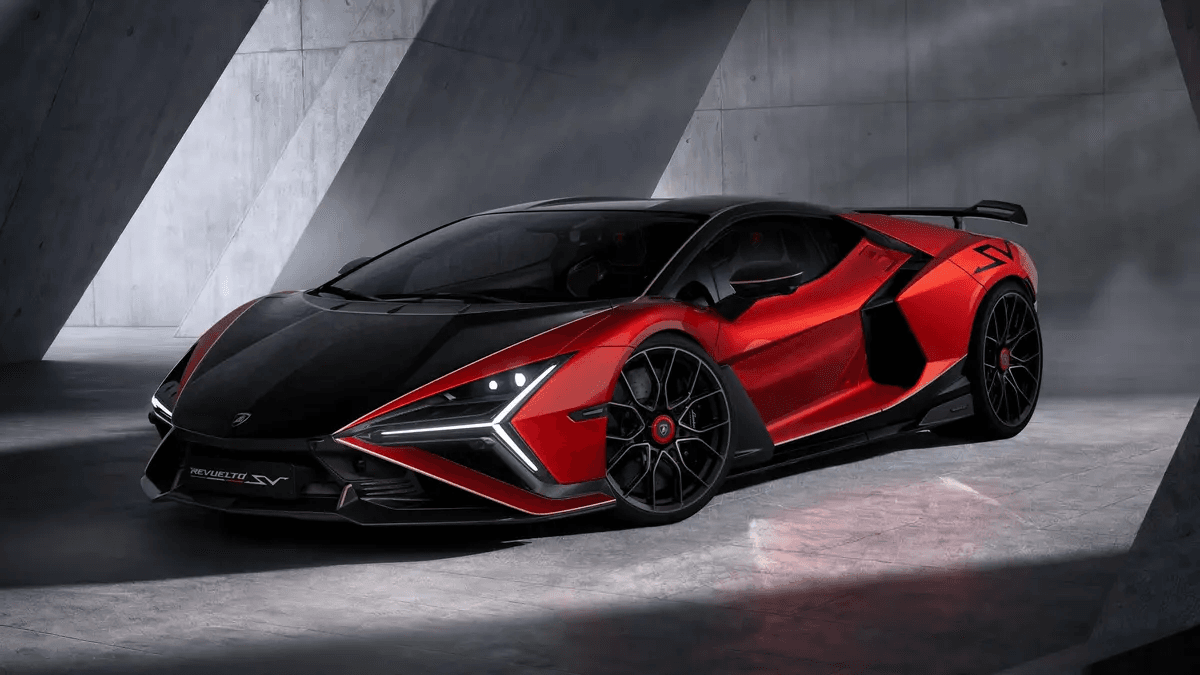
Like previous flagship models such as the Diablo, Murciélago and Aventador, it wears the SV designation. A special suspension system with manually adjustable dampers derived directly from GT3 racing cars, an enormous fixed rear wing generating maximum downforce at high speeds and aggressive quad exhaust outlets paired into two sections at the rear rank among the design’s most striking features.
Shortly before its official unveiling, the Revuelto SV, driven by factory chief test driver Marco Mapelli, completed a lap of the Hockenheimring in a breathtaking 1:41.6, setting the fastest homologated production-car lap record in Lamborghini history.
Black contrasting carbon details across the body, aerodynamically redesigned air channels and newly sharpened SV logos on both sides reinforce the model’s wild character.

McMurtry Spéirling Pure: The Record Breaker Arrives in Monterey
Only 100 examples of the Spéirling Pure will be produced, each built entirely by hand at the company’s facilities in the Cotswolds in the United Kingdom. Its starting price has been set at approximately $1.3 million before taxes.
There are, however, plenty of convincing reasons why such a tiny and rather strange-looking automobile should carry a price tag like that.

Following McMurtry Automotive’s legendary prototype that broke the Goodwood Hillclimb record, the Spéirling Pure has now reached its final production form. It is a pure-bred missile on wheels that is rewriting the rules of the electric track-car world.
Built using components that are 95 per cent completely redesigned compared with the prototype version, the McMurtry Spéirling Pure uses a pair of electric fans integrated into the floor of the car to generate an enormous two tonnes of downforce from 0 km/h—even before the vehicle begins moving.

In corners or under braking, it can generate forces of up to 3G, delivering a track experience that goes beyond even Formula 1 levels.
Equipped with a modular 100 kWh battery pack featuring improved Molicel cells, the car sends 1,000 horsepower to the rear wheels and accelerates from 0 to 96 km/h in just 1.55 seconds. At an LMP2 racing pace, it can provide a continuous driving range of between 40 and 50 kilometres.
User-friendly additions include a redesigned secondary door hinge to make getting in and out of the cockpit easier, integrated headlights for night driving, a hydraulically assisted F1-style steering system and a helmet/HANS storage compartment incorporated beneath the distinctive rear “swan-neck” wing.
The sound produced by the twin underfloor fans spinning at 23,000 rpm creates a characteristic jet-like acoustic signature reminiscent of an F/A-18 fighter aircraft taking off, while regenerative braking can recover up to 200 kW of energy.

McLaren McL 6GT: A Modern Tribute to Bruce McLaren
McLaren’s launch at Monterey 2026 contained one of the event’s most understated yet significant new arrivals.
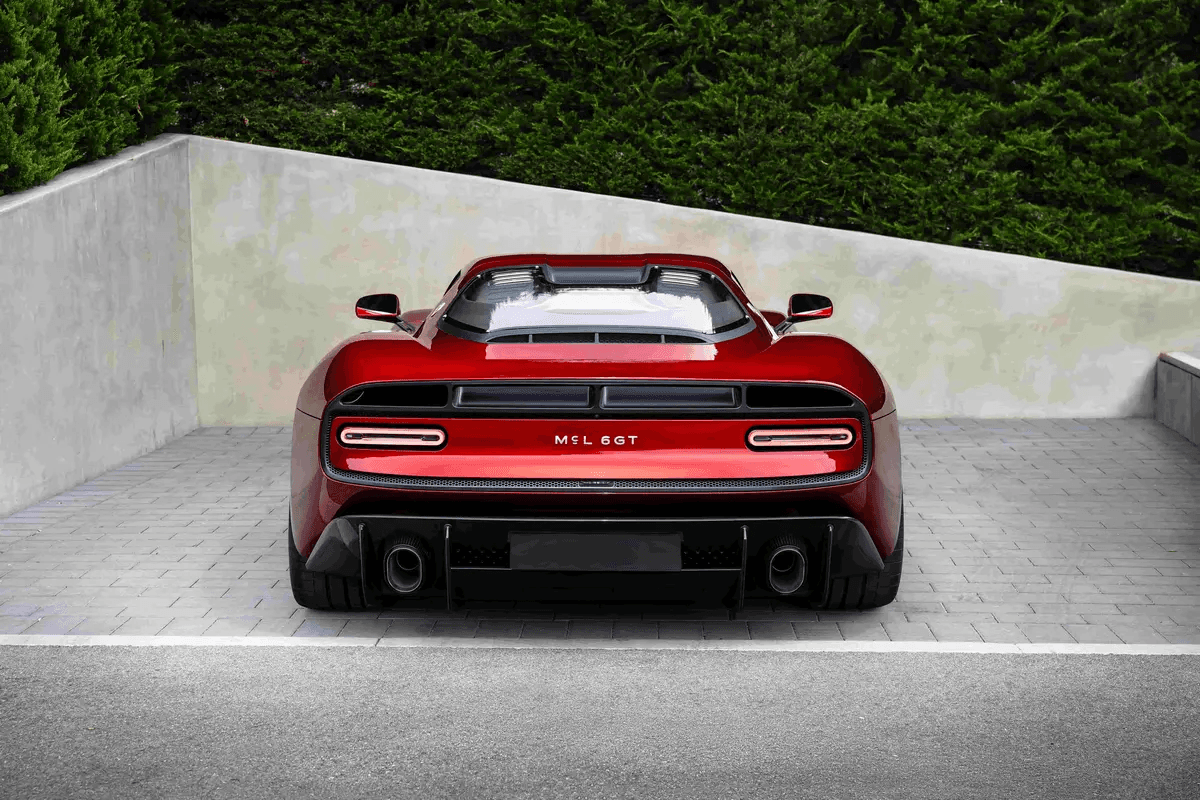
The new McLaren McL 6GT pays tribute to the original M6GT vision of the brand’s legendary founder Bruce McLaren in the 1960s, as well as to his racing heritage. It aims to become one of the purest analogue super sports cars of the modern era and will be limited to just 500 examples.

At a time when the hypercar world is increasingly dominated by digitalization and dual-clutch automatic transmissions, the McLaren McL 6GT places a six-speed manual gearbox—and, naturally, a three-pedal driving experience—at its very heart, reviving pure interaction between human and machine within a carbon-fibre body.
With the McL 6GT, McLaren is using a manual transmission in one of its cars for the first time since the legendary F1.
Scheduled to enter series production in 2028, the car combines the “Kammback” tail form of the 1960s with contemporary carbon-fibre architecture.
As a tribute to Bruce McLaren’s roots, special signature details appear in the engine compartment, while the brand’s classic “Speedy Kiwi” motif can be found on the gear knob and fuel cap. The registration plate of the original M6GT prototype has also been incorporated into the body as a subtle ton-sur-ton graphic.
Porsche Flachbau RS: The Return of the Slantnose
With the Flachbau RS, Porsche arrived at Monterey 2026 drawing inspiration from the legendary 935/78 “Moby Dick” racing car and the iconic “Slantnose” design heritage of the 1980s.
The decision to revive the design stems from the cult 1980s look in which Porsche’s traditional round headlights were replaced by concealed pop-up units—a style that also became known as the “slant nose.”

Built entirely by hand by Porsche’s Sonderwunsch department for a private collector, only a single Porsche Flachbau RS has been created, and the car also complies with road-registration requirements.
Based on the Porsche 911 GT2 RS Weissach Package platform, the Porsche Flachbau RS combines the legendary silhouette with modern engineering through lowered fenders, an enormous S-armed active rear wing and a stepped, ultra-thin LED lighting architecture concealed when the headlights are switched off.
Additional weight-saving measures have also made the car approximately 32 kilograms lighter than the standard GT2 RS.

Spyker C8 Preliator XXV Concept: The Flying Dutchman Returns
One of the standout boutique automotive brands of the 2000s, Spyker signalled its comeback with the C8 Preliator XXV Concept.
Twenty-five years have now passed since the historic Dutch marque was reborn, and in keeping with that theme, production of the new model will be limited to just 25 examples. With prices starting at $1.6 million, 19 of those cars are reportedly already sold.

The project has been made possible with financing provided by Ukrainian crypto billionaire Volodymyr Nosov, while Dutchman Victor Roberto Muller, Spyker’s founder, remains at the helm.
The Spyker C8 Preliator XXV Concept brings the brand’s characteristic design into the present day through new materials and powertrains.
Its 4.0-litre twin-turbocharged V8 produces 800 horsepower and 1,000 Nm of torque, allowing the 1,525 kg car to accelerate from 0 to 100 km/h in 2.7 seconds and reach a top speed in excess of 350 km/h.
Inside, genuine rose gold, cast aluminium and Nappa leather combine with an exceptional level of craftsmanship, while the exposed gear-selector mechanism remains one of the cabin’s most distinctive details.

Legendary Cars Sold for Record Prices
Iconic Cars from the Movies Up for Sale
Special Edition: Ferrari’s Anniversary Cars