Six buildings, 55 rooms, 500 works of art… Maison Bond Street, Hermès’ sixth Maison worldwide, celebrates the French house’s more than 60-year relationship with Britain while reinterpreting its vision of craftsmanship and the art of living in the heart of London.
Hermès is going through a period defined by movement and transformation. It almost feels as though the stars have aligned and the planets themselves are moving according to the Hermès calendar. It all began around this time last year. First came the announcement that Véronique Nichanian, who had shaped the house’s menswear collections for 37 years, would step down from her role. She was succeeded by British designer Grace Wales Bonner. In a move rarely seen in luxury fashion, Hermès has given its new creative leader time to develop her vision without haste; Wales Bonner’s first menswear collection will not debut until next January during the fashion weeks.
A new chapter is also opening for Nadège Vanhée, who has spent the last 12 years shaping the elegance and contemporary wardrobe of the Hermès woman. She is now taking on a much larger responsibility. The house will present its first haute couture collection in January 2027, marking the beginning of a new haute couture era in Hermès history.
Maison Bond Street / Valérie Sadoun
Unlike many of its competitors, Hermès has traditionally avoided using destination shows as a communications tool. Yet last month it made one of the rare exceptions in its history with an event in Los Angeles. At the same time, the company continues to be one of the strongest players in the industry financially. Hermès closed 2025 with €16 billion in revenue and generated €4.1 billion in the first quarter of 2026. While reported figures declined by 1 percent due to currency fluctuations, growth at constant exchange rates reached 6 percent—a remarkable achievement in today’s luxury landscape. Strong performances in the United States, Japan and Europe once again demonstrated the brand’s resilience despite the broader slowdown in the global luxury market.
While much of the luxury industry has spent the last decade focused on scaling up, expanding into more categories and increasing visibility, Hermès has come to represent something different: restraint. Today, Hermès stands as a business model for managing desire and patience. While many industry players equate growth with increased volume, Hermès has done the opposite. It has kept production limited, continued investing in craftsmanship and preserved its workshop-based structure. In doing so, it has demonstrated that luxury is still rooted more in inaccessibility than accessibility, proving that controlling supply can be a more powerful strategy than stimulating demand. Hermès represents not only wealth but also a form of cultural confidence. It is an approach that places discretion above spectacle, permanence above novelty and elevates slowness to a virtue in an age obsessed with speed.
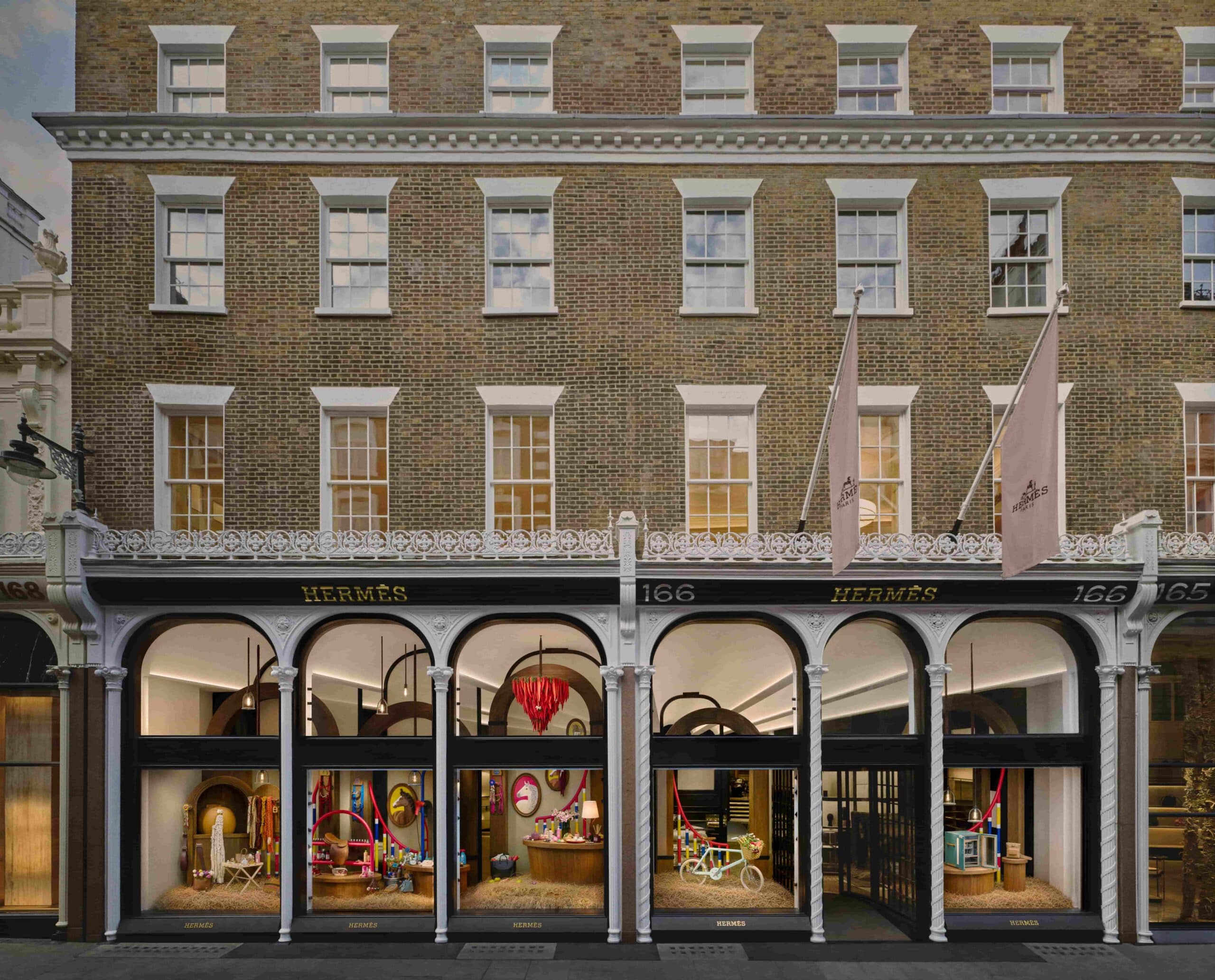
The new Maison on New Bond Street is not merely Hermès’ sixth flagship in the world; it is also an architectural expression of the house’s growth strategy and its desire to look toward the future while remaining rooted in its heritage. Comprising six buildings and 55 rooms, Maison Bond Street celebrates the French maison’s centuries-spanning relationship with Britain while reinterpreting its vision of craftsmanship, culture and the art of living in the heart of London.
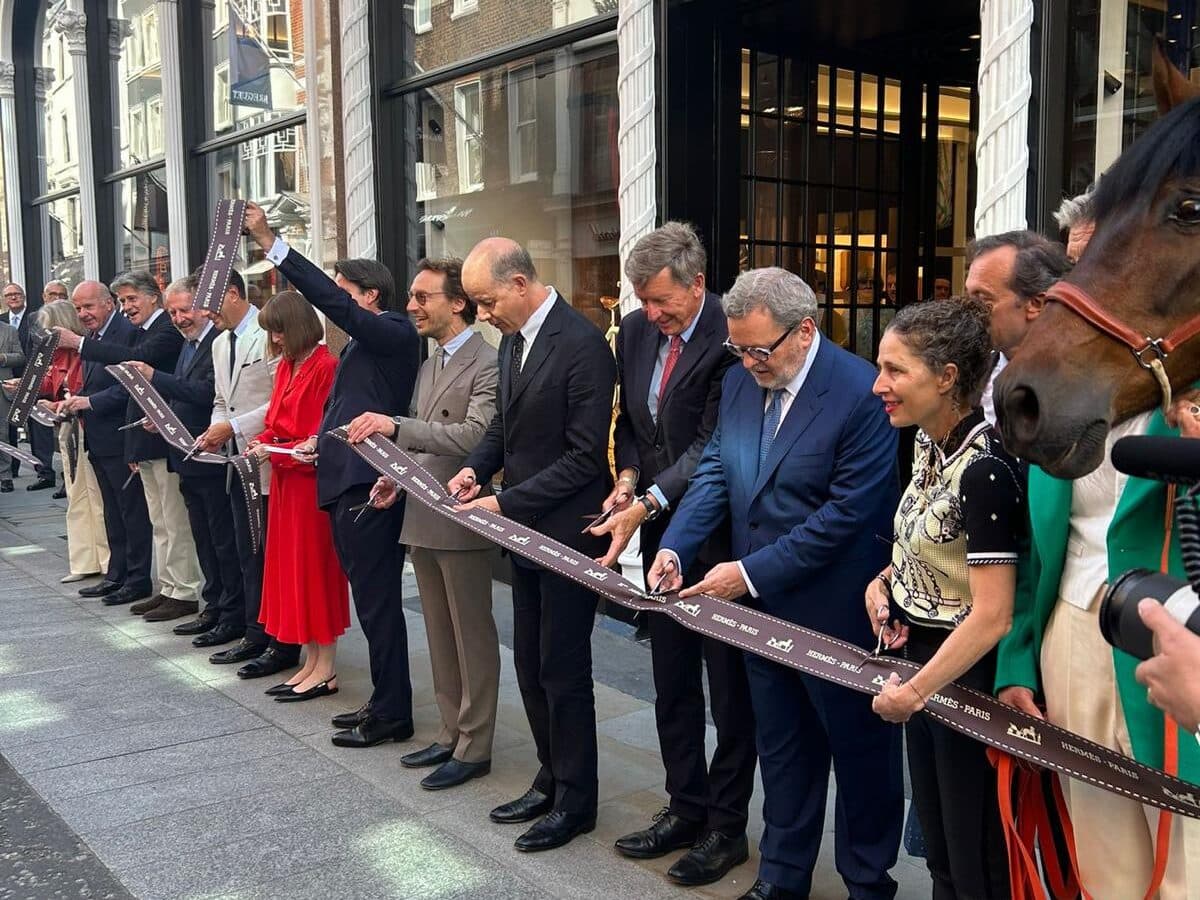
June 16, 2026. The sixth Maison. Number 166 on New Bond Street. You may have noticed something intriguing. Hermès CEO Axel Dumas insists that it is no coincidence. “For those who enjoy numbers: the digits of 166 add up to 13, which then becomes 4. Multiply that 4 by 6, since London is Hermès’ sixth Maison, and you arrive at 24—the address of the original Maison at 24 Faubourg Saint-Honoré. It seems even mathematics is on Hermès’ side.”
Maison Bond Street
But First, a Little Nostalgia
The story begins in 1837, when Thierry Hermès opened a small harness workshop in Paris. It was an era defined not by automobiles but by horse-drawn carriages, and Thierry Hermès built his reputation through saddles and harnesses renowned as much for their elegance as for their durability. The saddle-stitch technique, still used today on Hermès bags, traces its origins to that period and became one of the foundations of the house’s obsessive dedication to craftsmanship.
By 1880, his son Charles-Émile Hermès had moved the family business to what would later become the legendary address of 24 Faubourg Saint-Honoré. Initially little more than a workshop and boutique, it would eventually become the heart of the Hermès universe. Yet the true modernization of the house began under Charles-Émile’s son, Émile Hermès. Living through a period of rapid technological and social change between the two world wars, Émile was also an avid collector. His fascination with history, art and crafted objects created the cultural layers that remain inseparable from Hermès today.
In 1945, he chose a drawing by Alfred de Dreux depicting a horse-drawn carriage and coachman from his collection as the symbol of the Maison. The origins of the Duc Attelé logo, still seen on Hermès boxes and invitations, can be traced back to this decision.
Perhaps this is the perfect moment for a charming story about Émile Hermès the collector. According to Pierre-Alexis Dumas, his great-great-grandfather would spend every lunch break visiting auction houses. His wife was less than thrilled, as Émile seemed to return home almost daily with a new object, painting or toy. By the time he passed away, his office resembled a small museum more than an executive workspace. Many of the pieces now displayed on the walls of Maison Bond Street are part of the legacy of that insatiable curiosity.
Maison Bond Street / Valérie Sadoun
Maison Bond Street / Valérie Sadoun
24 Faubourg Saint-Honoré continued to grow. Two additional floors were added in 1926, a rooftop terrace was created and the display windows were redesigned to bring more daylight inside. Annie Beaumel, a former glove seller, transformed the store windows into miniature theatrical stages. These imaginative compositions facing the streets of Paris soon attracted international attention. If window design is considered an art form in fashion today, Hermès deserves much of the credit. Ostrich eggs, exotic plants, desert scenes and fantastical animals became part of a dreamlike world that drew visitors from around the globe to 24 Faubourg.
Today, that tradition continues in London, following Faubourg Saint-Honoré in Paris, Madison Avenue in New York, Ginza in Tokyo, Dosan Park in Seoul and Maison Shanghai.
London, A Hermès Collage
In reality, Hermès’ new London address is not a single building. It is a kind of architectural collage formed by the gradual merging of six separate structures, once owned by Asprey and dating back to the 18th century. Over the years, these interconnected buildings have housed everything from offices to jewelry workshops. Following a five-year restoration, Paris-based architecture firm RDAI chose not to erase the building’s layered history, but to reveal it.
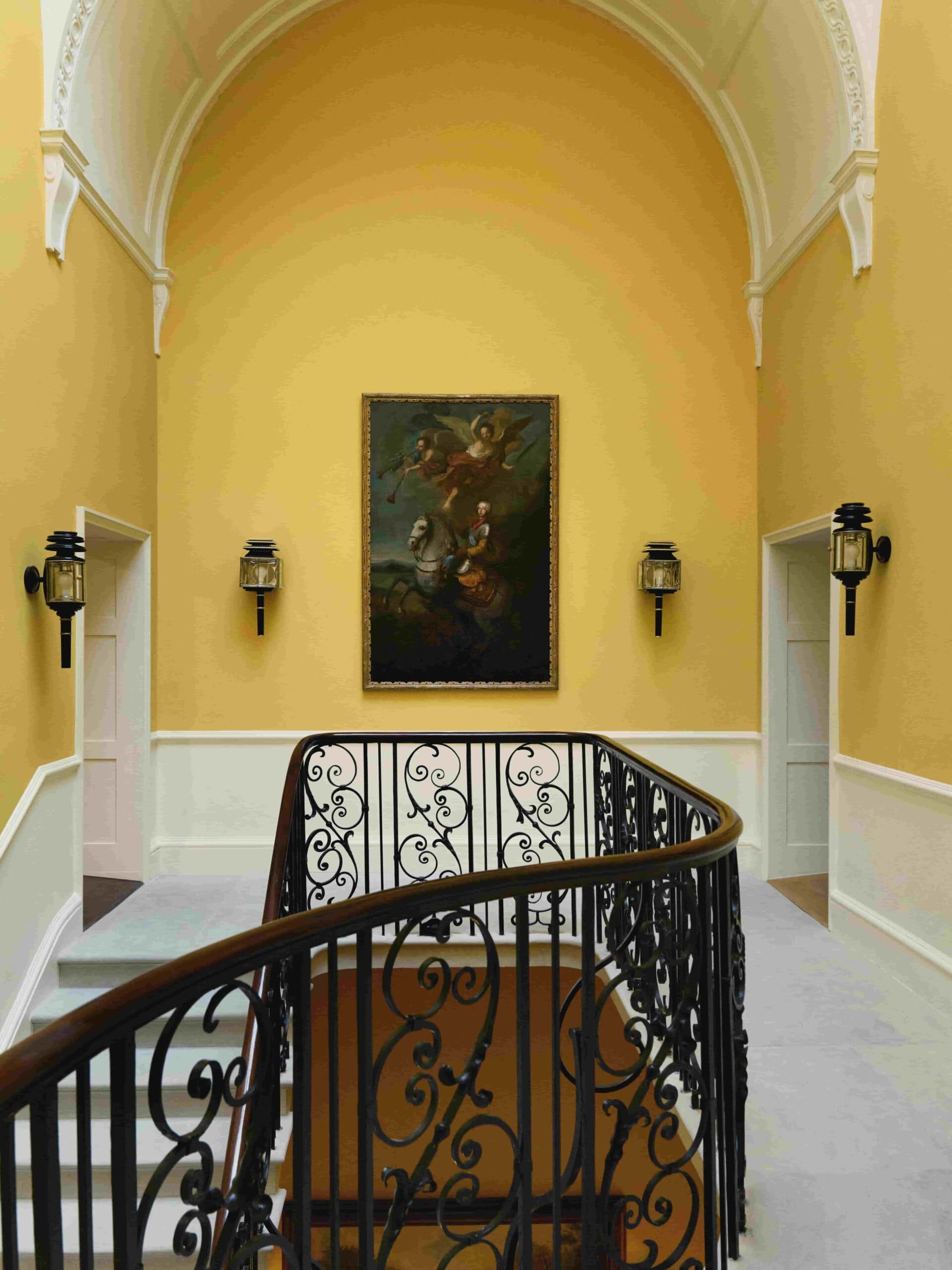
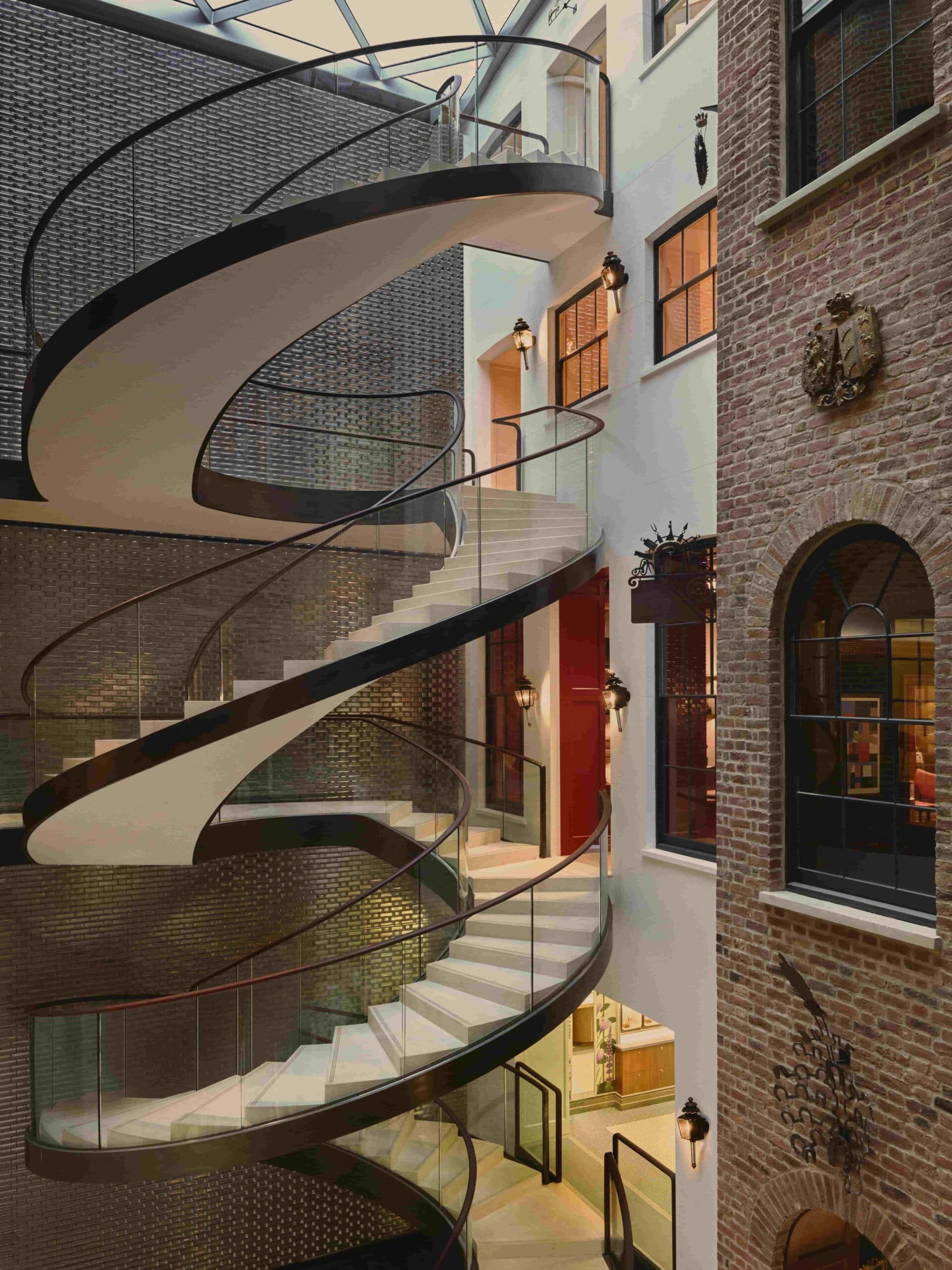
Perhaps the most striking element is the spiral staircase designed years ago by Norman Foster, along with the glass canopy above it. In many ways, Maison Bond Street feels like an architectural expression of everything Hermès values: different eras, craftsmanship, memory and details that unfold over time.
Maison Bond Street / Valérie Sadoun
Maison Bond Street / Valérie Sadoun
Hermès’ relationship with Britain stretches back much further than many might imagine. It can be traced to the friendship between Robert Dumas and British entrepreneur and restaurateur Mark Birley in 1961. Together, they decided to open Hermès’ first London address in Piccadilly Arcade, marking the beginning of the French maison’s journey in the United Kingdom.
“My grandfather believed Hermès was the most English of all French fashion houses,” Pierre-Alexis Dumas recently told the Financial Times. “I see this project as a tribute from a French maison to British culture. I believe our destinies are intertwined.”
The driving force behind Maison Bond Street is Pierre-Alexis Dumas himself. As he jokingly admits, the project is his “baby.” His role at Hermès is far too broad to be summarized by a single title. Above the women’s and men’s collections shaped by Nadège Vanhée and Grace Wales Bonner, he serves as the person who connects the brand’s entire visual universe. From the architecture and interiors of Hermès stores around the world to the artworks displayed on their walls and their decorative language, every detail passes through his oversight.
He is also the guardian of the heritage collection known today as Le Conservatoire des Créations Hermès, an archive built from the thousands of objects collected by Émile Hermès over the years.
Located just a few steps south of the former flagship, Maison Bond Street is Hermès’ fourth address in London. Spanning approximately 2,000 square meters and combining six historic buildings, it is also the brand’s sixth Maison worldwide. Walking through the space, it is easy to feel as though you are inside the home of a collector.
The roots of this philosophy lie at 24 Faubourg Saint-Honoré in Paris. The first Maison, where Émile Hermès’ office remains preserved and where the atmosphere was intentionally conceived as that of a family home, served as a key reference point for Pierre-Alexis Dumas. When envisioning the London project, he sought to carry that same spirit forward.
More than 500 artworks are displayed throughout the building, many selected from the Émile Hermès Collection’s archive of 20,000 pieces. In that sense, Maison Bond Street feels less like a flagship store celebrating Hermès’ long relationship with Britain and more like a multi-layered home where the maison’s vision of craftsmanship, art and lifestyle has been reimagined in London.
Maison Bond Street / Valérie Sadoun
The complex, whose origins date back to 1769, evolved into its current form through the combination of six buildings spread across five floors. Redesigned by RDAI, the project resembles one of the layered stories Hermès loves so much. Four staircases, three elevators, two rooftop terraces and 55 rooms with distinct personalities create the sensation of wandering through a grand private residence rather than a retail space.
It is entirely possible to lose your sense of direction moving from one room to another. In fact, that is part of the intention. Hermès conceived the new Maison not as a linear shopping experience, but as a place to be explored. Each room opens onto one of the brand’s 16 métiers, while traces of the building’s past have been consciously preserved. Historic walls, period details and decorative elements coexist alongside contemporary furniture and new interventions.
As a result, the building feels less like a newly constructed flagship and more like a living home that has accumulated layers over centuries.
Maison Bond Street / Valérie Sadoun
Maison Bond Street / Valérie Sadoun
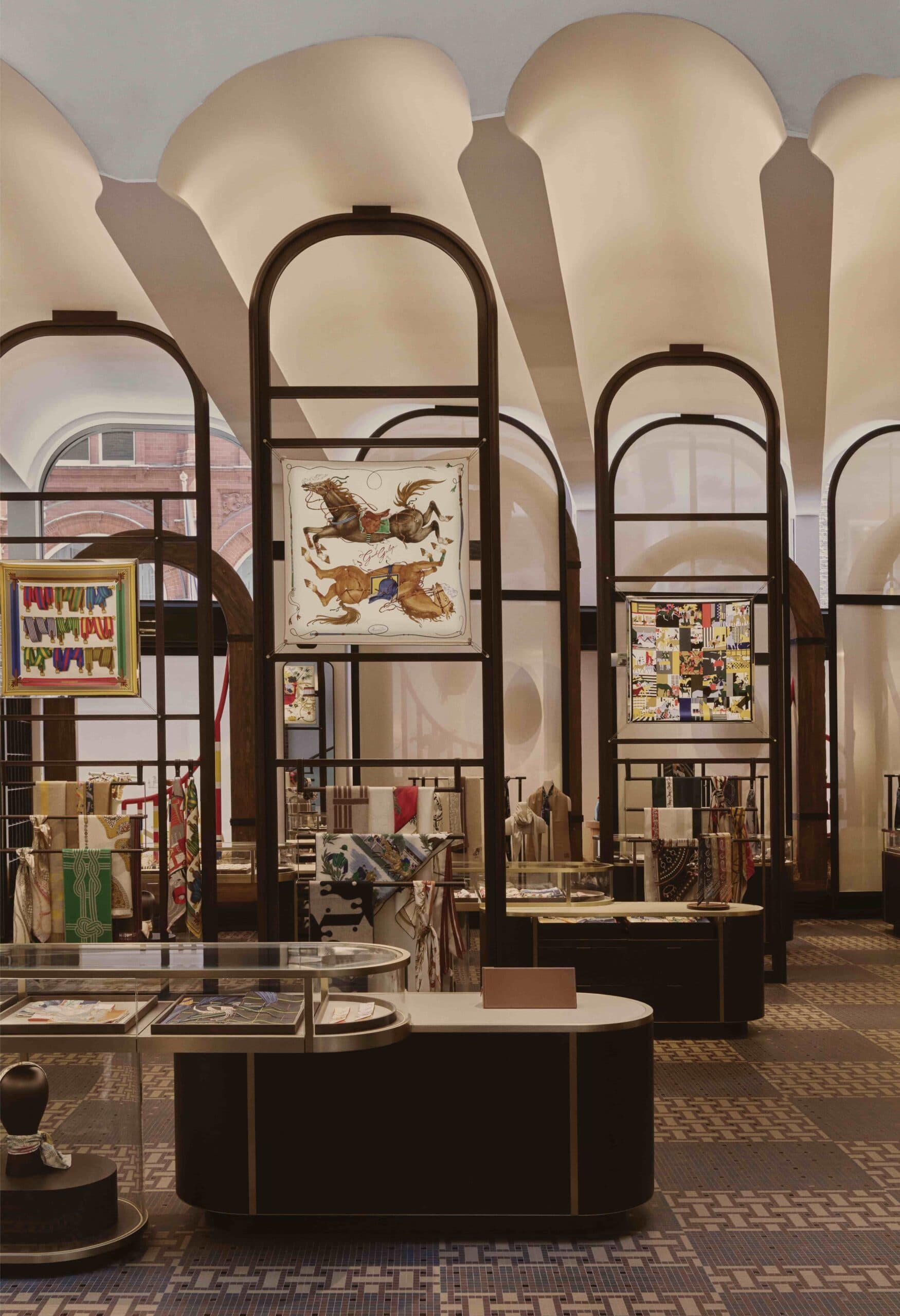
Stepping through the seven-meter-high façade, visitors enter what could be described as the heart of the Maison. The floor, rendered in shades of chocolate, coffee and chalk, features Hermès’ iconic ex-libris emblem. Black glass studs and a vaulted ceiling that echoes the six arched windows of the façade create an atmosphere that feels part optical illusion, part theater.
This entrance area is dedicated to the world of Hermès silk. Softly curved cherrywood displays are nestled within the lofty arches, giving the impression that the scarves are not being sold, but staged.
Maison Bond Street / Valérie Sadoun
From here, the journey leads into the atrium, one of the building’s most impressive spaces. Once an open-air courtyard, it has been reimagined by Foster + Partners. A new steel-and-glass roof raises the space by an additional level, while the spiral staircase beneath it has been extended by two more floors.
Finished with limestone, glass and calfskin-covered railings, the staircase has become the architectural centerpiece of Maison Bond Street. The south wall, once covered in mirrors, has been reinterpreted with reflective glass blocks inspired by Manchester brickwork. The dialogue between historical layers and contemporary interventions is perhaps felt most strongly here.
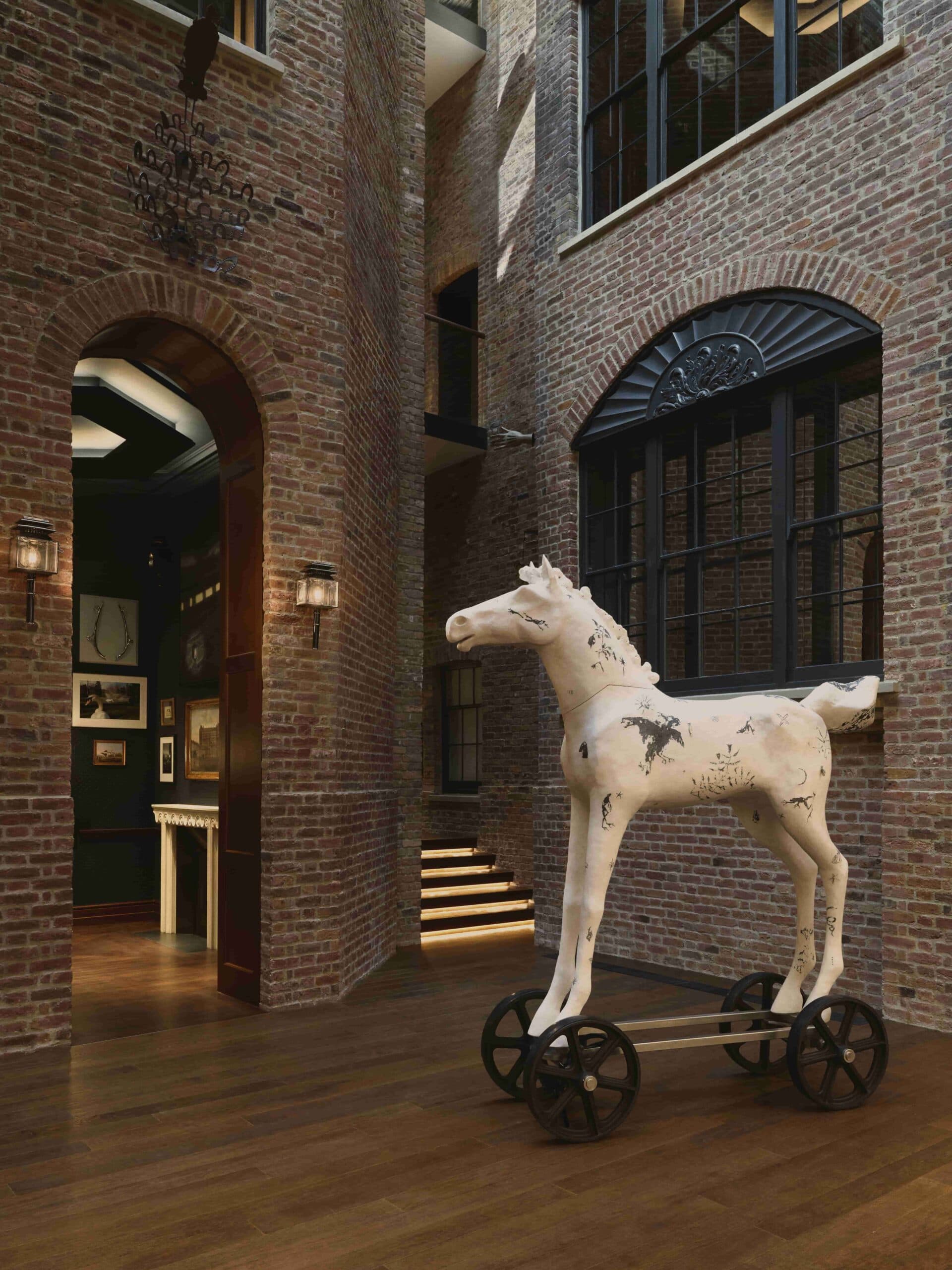
Under the artistic direction of Pierre-Alexis Dumas, decoration and art are inseparable at Maison Bond Street. A perfect example is the horse sculpture created exclusively for Hermès by British artist Jessica Wetherly, positioned at the center of the atrium.
Designed almost as if it were a living presence, the sculpture subtly references the maison’s equestrian heritage while bringing a sense of movement to the space. Indeed, the entire Maison is built around this idea: historical objects, photographs, illustrations and contemporary designs coexist with the collections as though they are all part of the same narrative.
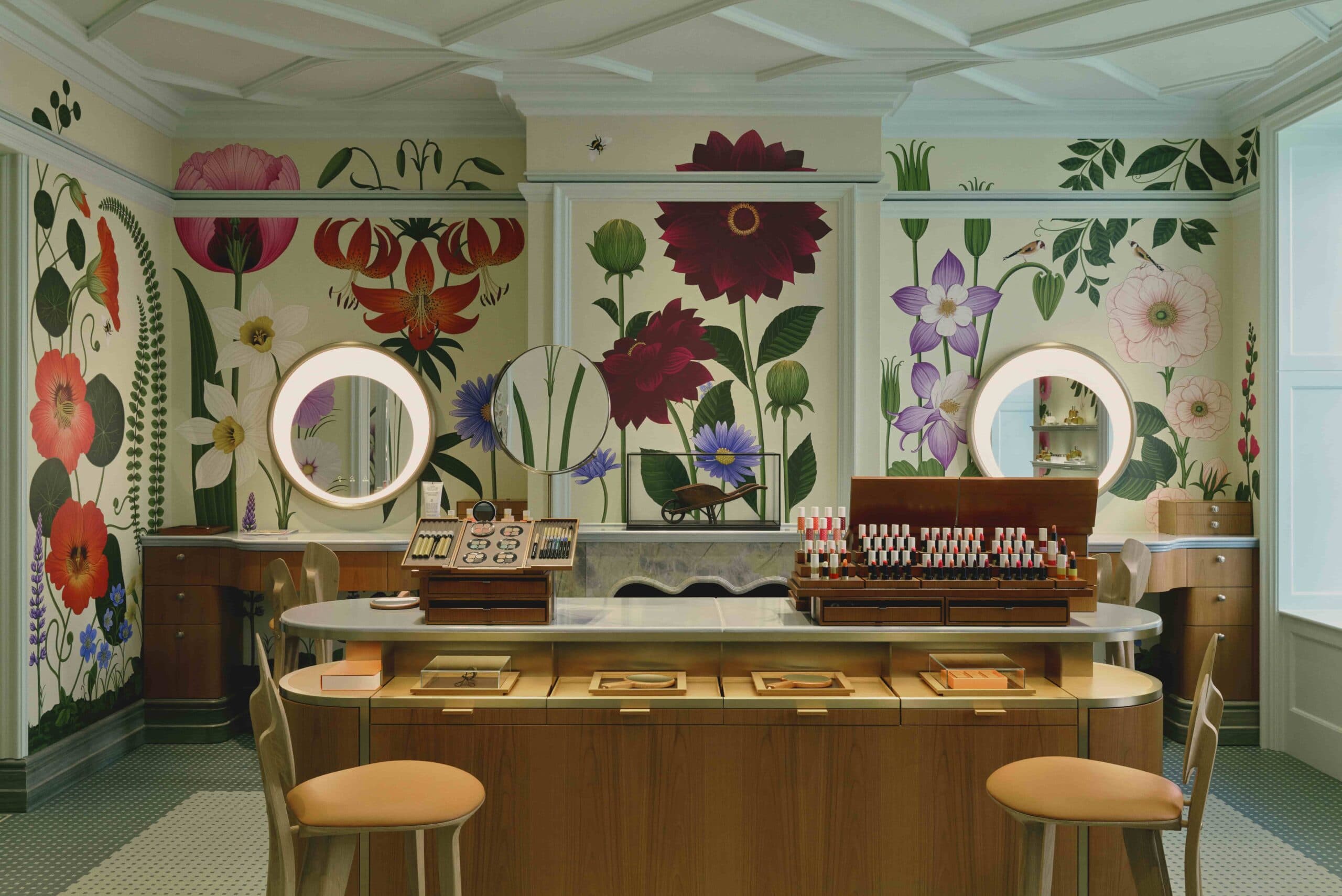
The second entrance leads to the beauty, fragrance and fashion jewelry section, a space that resembles an imagined winter garden. Botanical wallpapers created by London-based illustrator Katie Scott, green-toned mosaic floors, rattan tables topped with lava stone surfaces and a Ledmore green marble fireplace lend the area a distinctly romantic English countryside atmosphere. Cherrywood cabinetry and patterned plaster ceilings further reinforce this feeling.
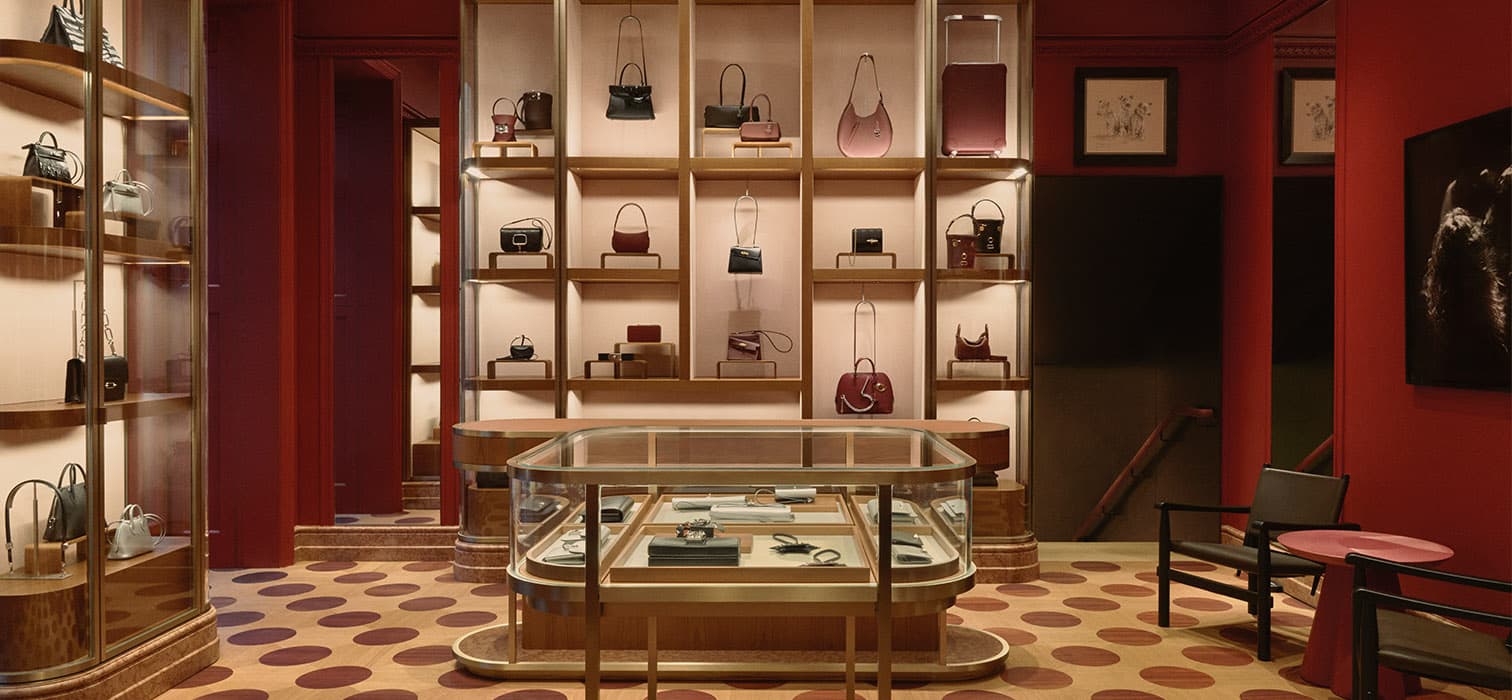
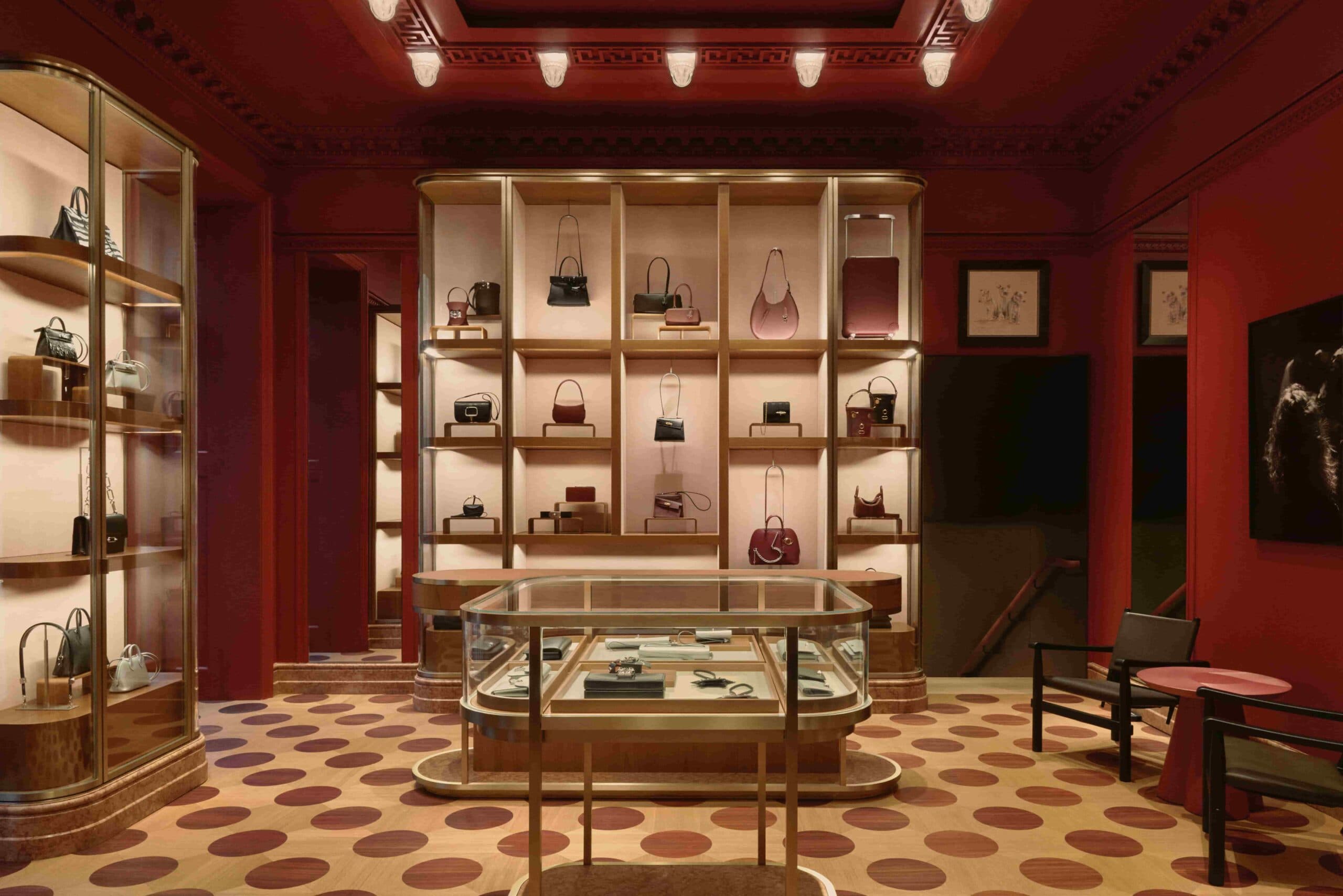
Ascending to the first floor, the atmosphere changes completely. A sequence of 20 interconnected rooms begins with deep crimson salons dedicated to Hermès leather goods. Red lacquered domed ceilings, graphic parquet floors crafted from oak and bloodwood, and walls that gradually deepen in tone create an almost cinematic effect. The cherrywood furnishings are upholstered in Hermès’ iconic Toile H fabric.
Alongside leather goods and silk scarves created exclusively for the opening of Maison Bond Street, visitors will also find objects by Ateliers Horizons, jewelry, watches and fragrances displayed throughout the space.
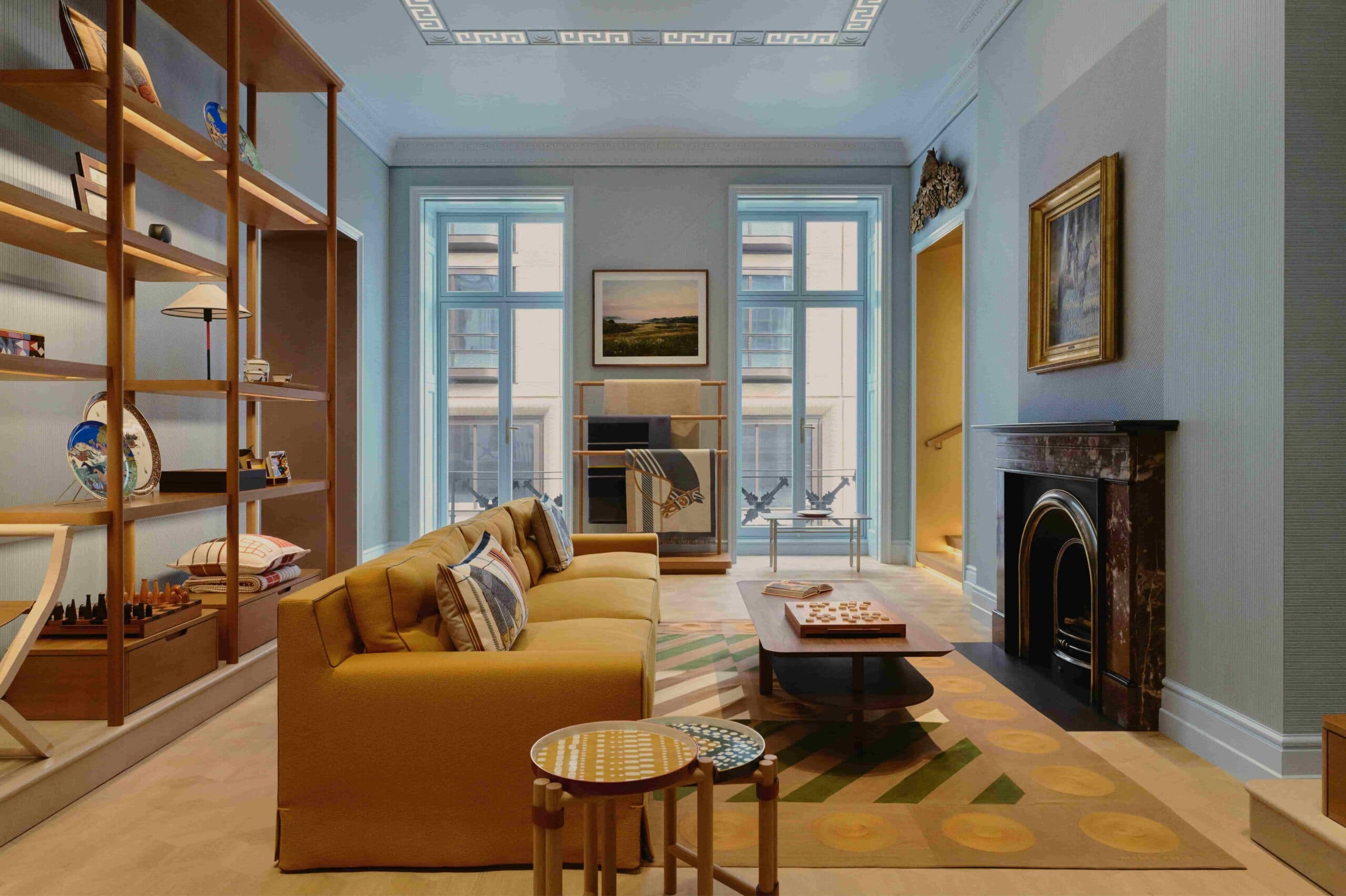
Transition spaces connected by patinated copper panels lead into a calmer world dedicated to the home collections. Hexagonal oak parquet flooring harmonizes with decorative elements inspired by historic plaster ceilings, while shades of blue and green, embossed carpets and carved wood panels create a softer atmosphere.
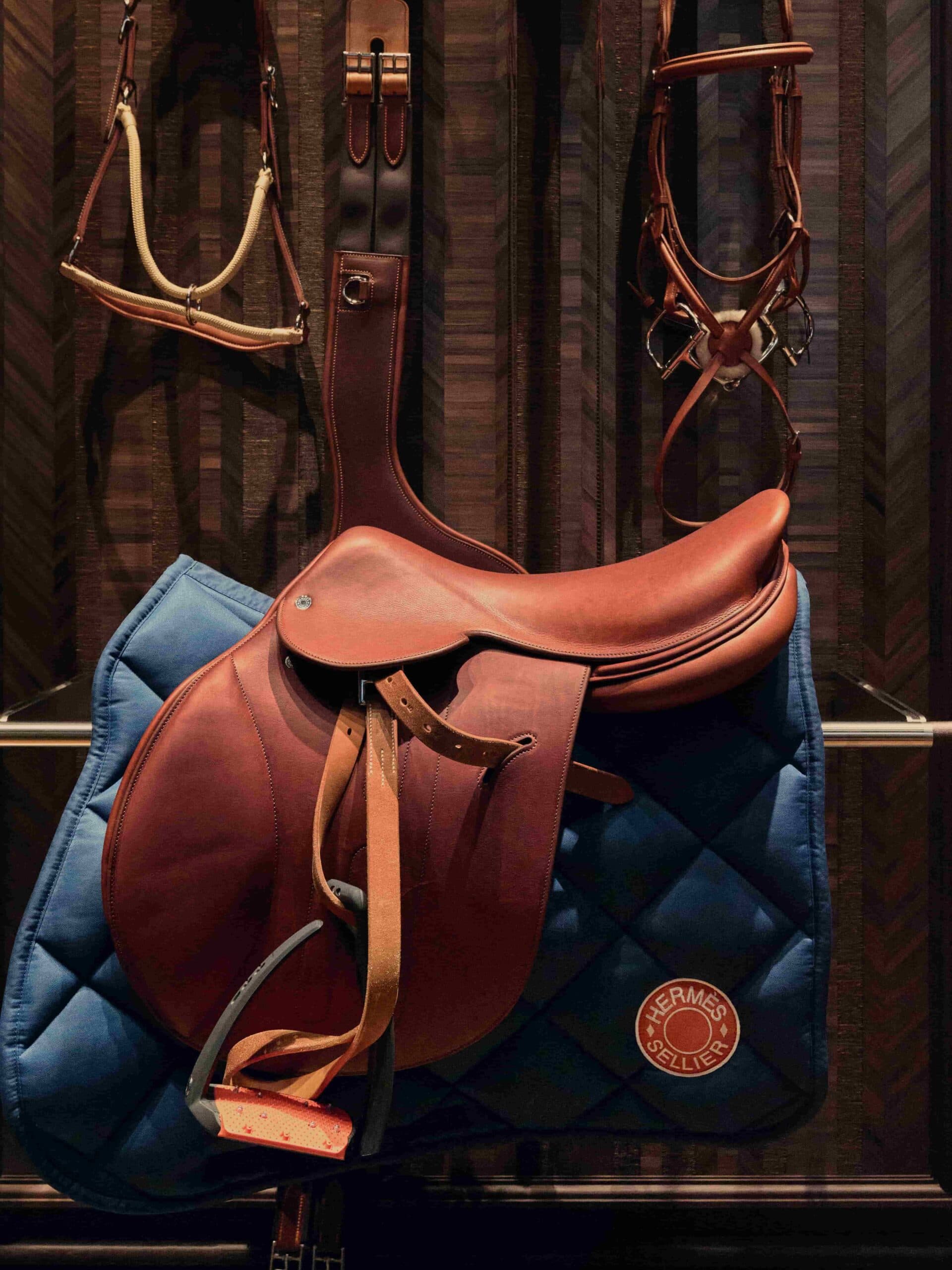
At the center of the floor, overlooking the atrium, is a dedicated equestrian section that pays tribute to Hermès’ origins. Surrounded by inlaid panels made from straw and horsehair, it is one of the spaces where the connection between the Maison’s past and present is felt most strongly.
Maison Bond Street / Valérie Sadoun
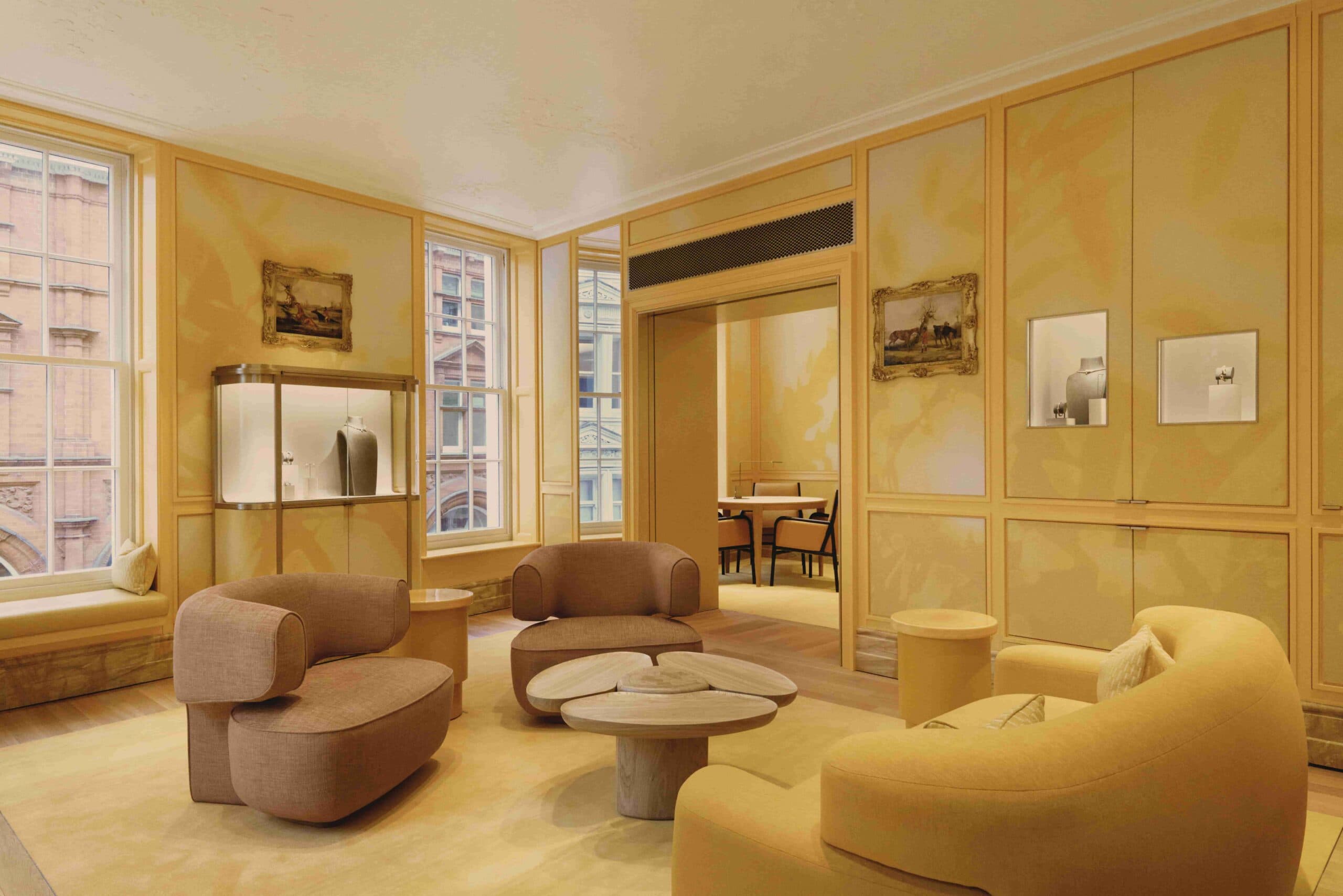
The six rooms lining the New Bond Street façade are devoted to watchmaking and jewelry. Wall coverings inspired by sunlight filtering through trees, Siena yellow marble accents and ceramic-topped display tables create a serene and luminous environment. Decorative plasterwork, finely crafted ceilings and handmade details produced by local artisans reflect Hermès’ commitment to craftsmanship in even the smallest details.
On the second floor, the atmosphere shifts once again. Powder pink tones dominate the women’s footwear department. Hand-applied mineral plasters, traditional wood paneling and carpets patterned with oversized English flowers evoke the feeling of a romantic English country house. Hexagonal brushed copper fixtures and softly sculpted seating complete the elegant setting.
Maison Bond Street / Valérie Sadoun
Original 19th-century mosaic floors guide visitors through two private salons and into five rooms dedicated to women’s ready-to-wear. Walls whose pink tones gradually evolve from room to room, combined with handwoven carpets, create a seamless sense of movement throughout the space.
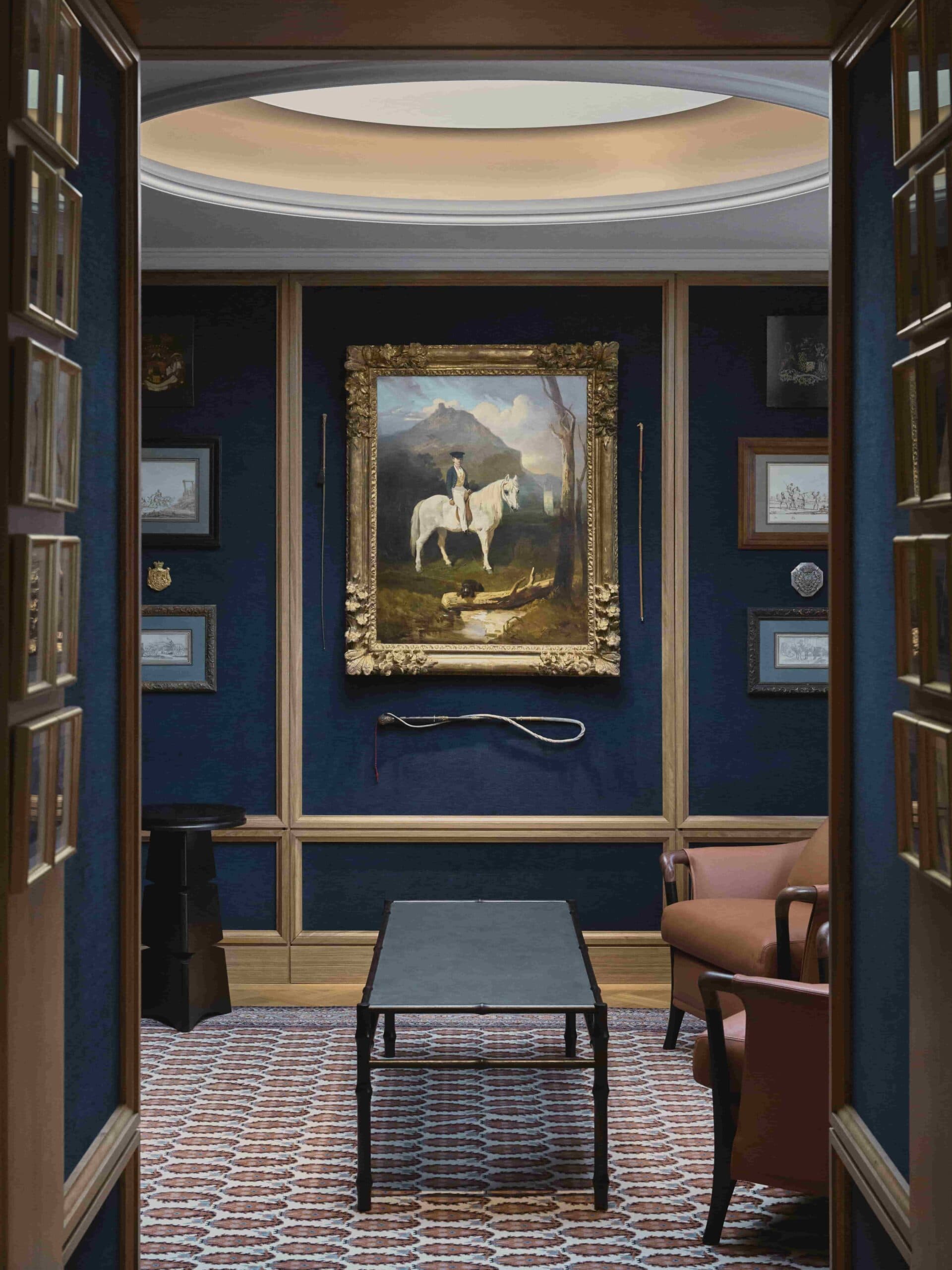
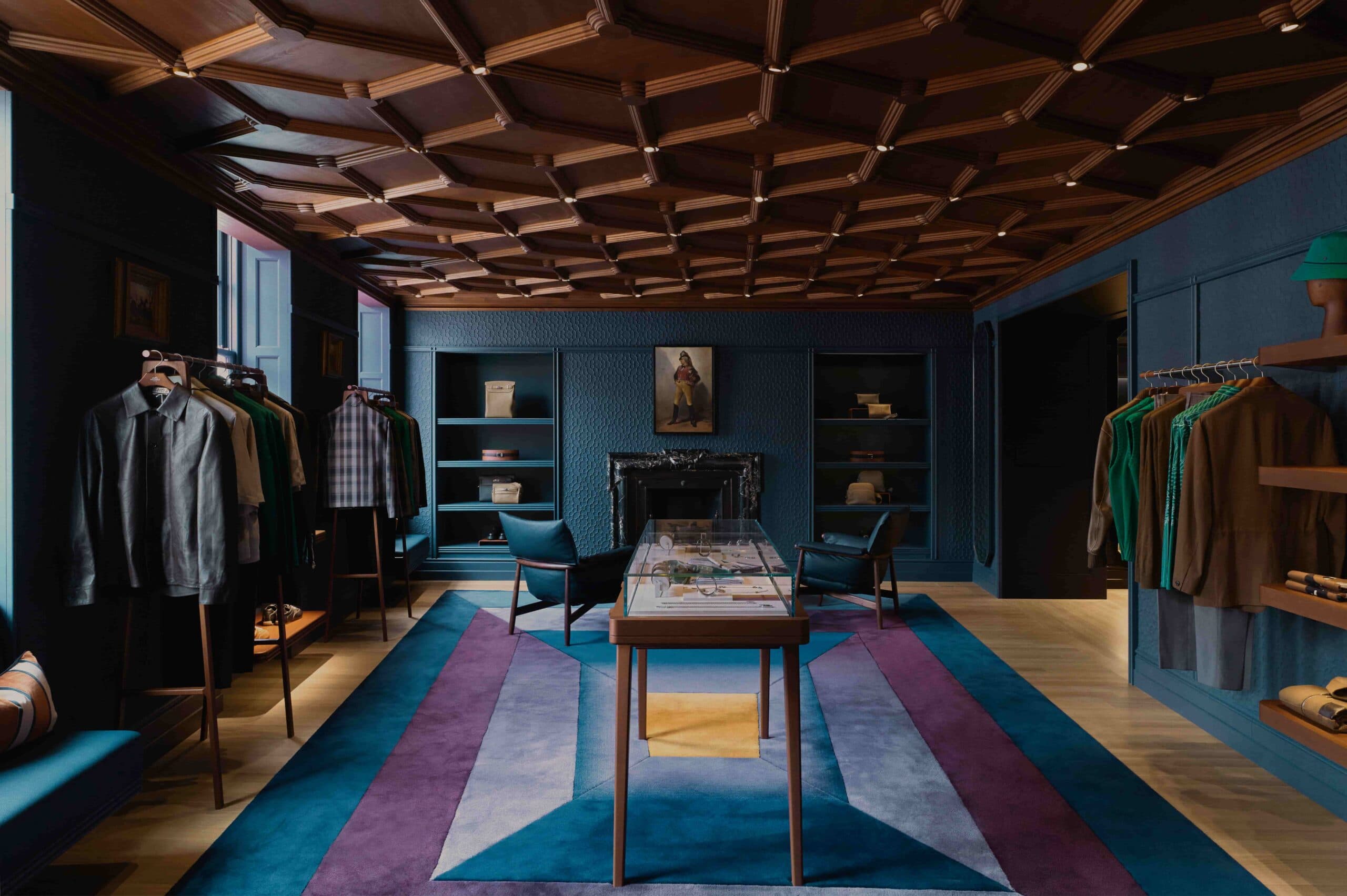
The men’s universe overlooking New Bond Street possesses an entirely different character. Reclaimed oak flooring and geometric carpets inspired by cherrywood-paneled ceilings lend the rooms a more graphic aesthetic. The dark blue textured wall coverings tell their own story. Developed during the Victorian era and still produced in Lancashire today, these materials form a quiet yet powerful expression of the dialogue Hermès seeks to establish between French craftsmanship and British artisanal traditions.
Maison Bond Street / Valérie Sadoun
The third floor is one of the places where the heart of Hermès beats most strongly. Here, leather artisans work not behind closed doors, but within the same environment as visitors. These craftspeople dedicate themselves to objects designed to be repaired, to grow more beautiful with age and to be passed down to future generations, making Hermès’ philosophy of production visible.
In many ways, this floor functions as a quiet manifesto, reminding visitors that the house believes more in time than in speed.
The top, fourth floor is devoted entirely to the Émile Hermès Collection. Inspired by the spirit of the private collection housed at 24 Faubourg Saint-Honoré in Paris, the space demonstrates how heritage and innovation can coexist through its vibrant colors, object-filled rooms and richly layered composition.
The attic salons have been conceived for private gatherings and special events.
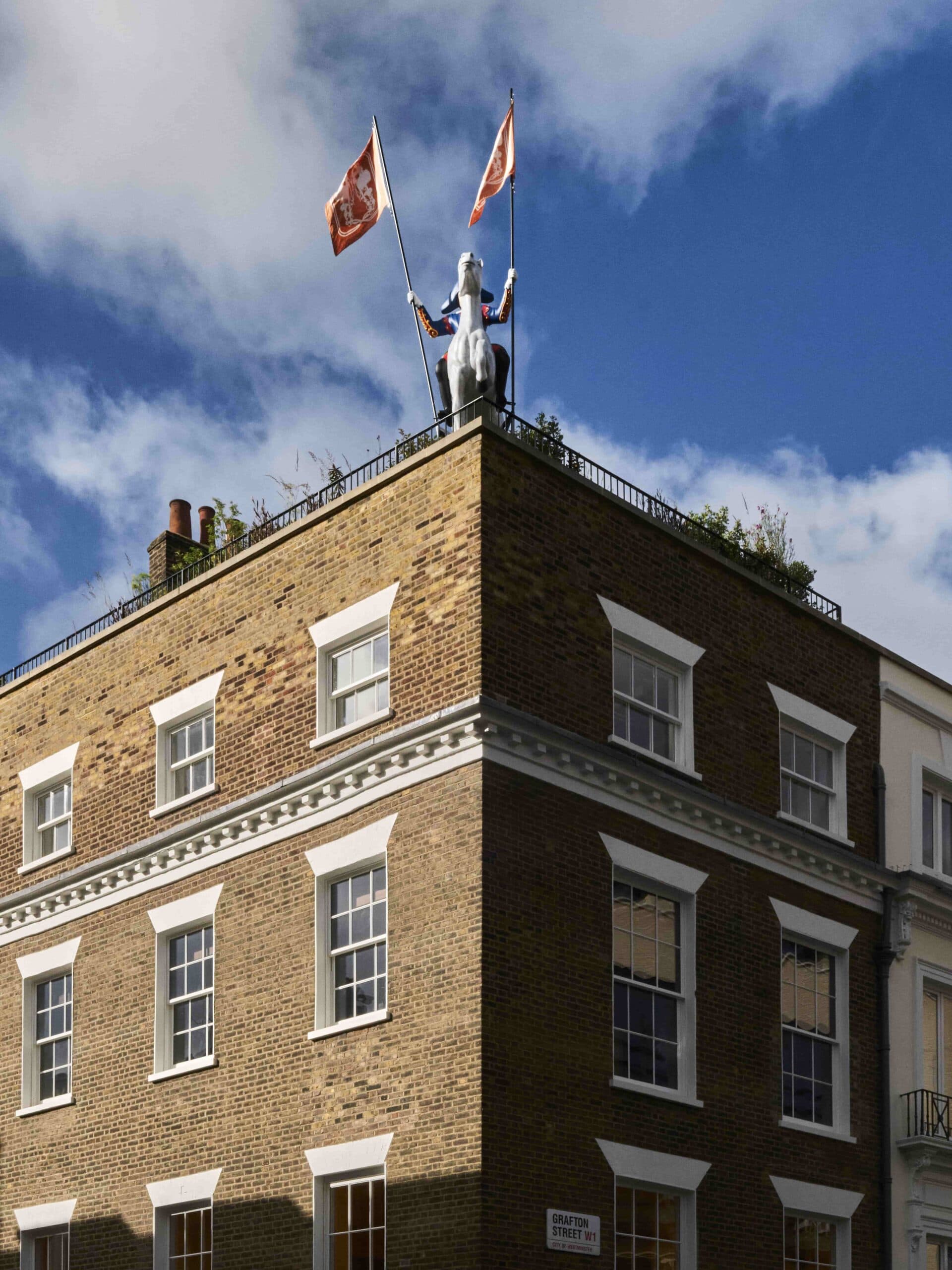
And of course, just as at Faubourg Saint-Honoré, a Hermès Maison would be incomplete without a garden. Two rooftop gardens extending toward New Bond Street and Grafton Street offer an unexpected sense of tranquility in the middle of London. These green spaces are accompanied by Artificier, the Maison’s standard-bearing horseman.
Ultimately, Maison Bond Street brings together Hermès’ decades-long relationship with Britain, its French tradition of craftsmanship and its philosophy of the art of living under a single roof. More than a flagship store, it is a living home—one that has accumulated new layers over centuries and continues to evolve with time.
Saatolog Yıllık Saat Dergisi Saatolog’un yeni sayısı, 2020’nin yarattığı bu dönüştürücü etkiden ilham alarak hazırlandı. Dünya dijitalin etkisiyle her zamankinden de hızlı bir şekilde ilerlerken yavaşlamanın da önemini sonunda kavramış bulunuyoruz ve bu tezatlık hayatlarımızın her anına etki ediyor. Biz de bundan yola çıkarak Saatolog 2020/21 sayısını ‘‘hızlı ve yavaş’’ teması altında hazırladık.