The 20-Year Legacy of Yalın Architecture: Yalın Şeyler
We explore an inventory of the projects designed by Yalın Architecture over the past two decades, as chronicled by architect Banu Uçak. Yalın Şeyler (Simple Things) is far more than a mere catalog; it is a narrative that deeply interrogates the evolving relationship between architecture and society.
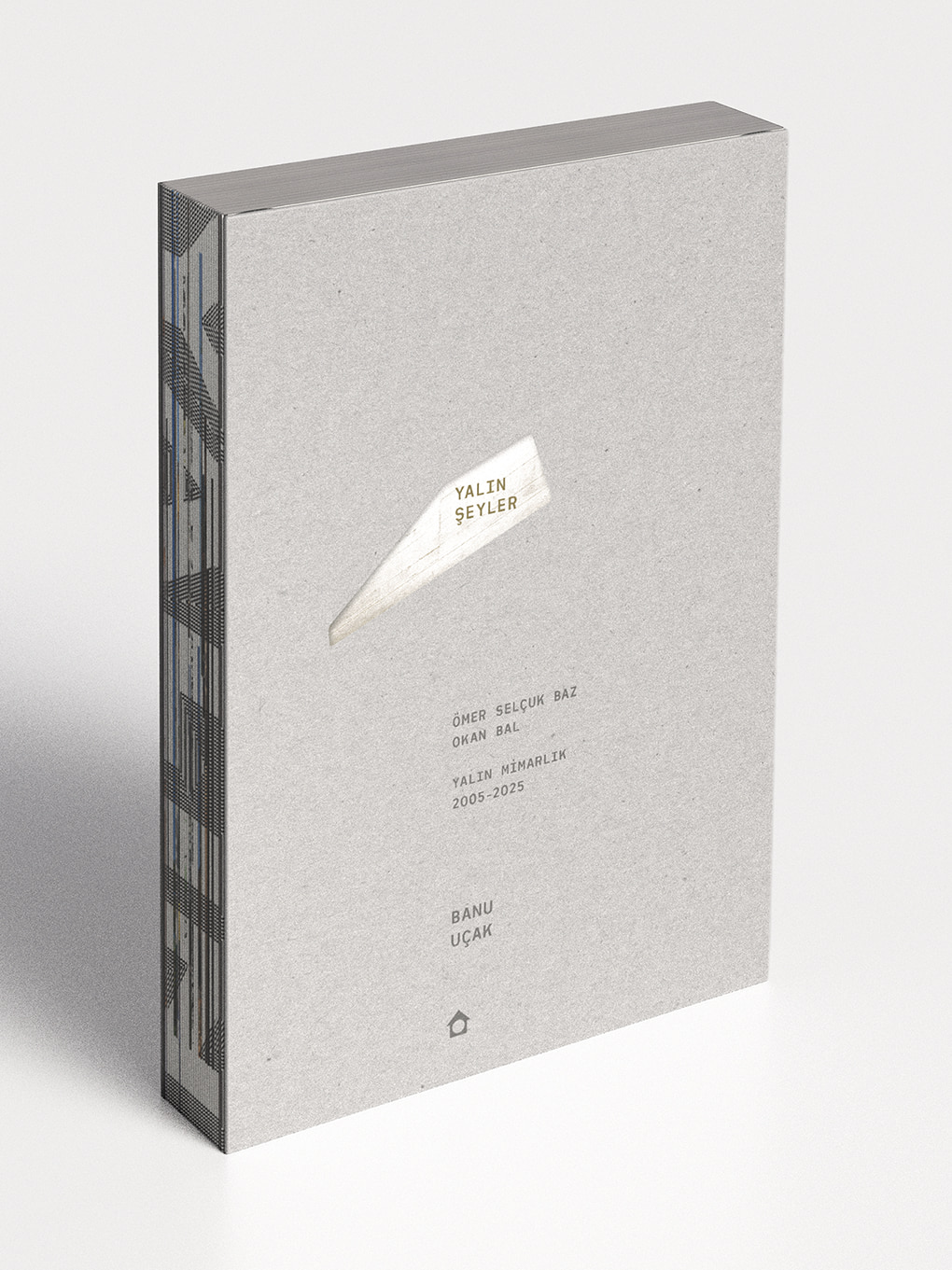
Recently, YEM Yayın (Yapı Eğitim Merkezi) released a compelling new volume titled Yalın Şeyler. This book serves as a retrospective of twenty years of practice by Yalın Architecture, a firm widely recognized for its visitor-centric approach to public space design. However, the publication departs from the standard architectural inventory. The author, Banu Uçak—an architect herself, though perhaps better known for her insightful architectural critiques—approached the project through a deeply personal lens. After engaging with the founding partners and examining their body of work, she sought to spark a broader discussion by linking the team’s output to the foundational pillars of the discipline.
The thematic sections of the book—Archetypes, Narratives, Patterns, Commonalities, Dialogue with Nature, Tectonics, and Collaboration—represent Uçak’s personal lexicon for Yalın Architecture’s design reflexes. At the same time, these themes connect the specific projects to universal architectural concepts that transcend geography. As Uçak suggests, readers of Yalın Şeyler can choose to follow the evolution of a single project across different thematic chapters or evaluate a group of works that share a similar conceptual DNA.
The book concludes with a poignant section titled “Open Wound,” authored by Ömer Selçuk Baz, one of the founding partners of Yalın Architecture. Originally from Antakya, Baz’s perspective on architecture was profoundly transformed by the personal losses and harsh realities he faced during the earthquake. In this closing chapter, he reflects on the internal scars left by the disaster and offers a revised vision of what architecture must become in its wake.
As someone observing from outside the professional discipline of architecture, I found the project narratives within Yalın Şeyler to be genuinely captivating. Whether detailing the Cappadocia Regional Museum, the Zonguldak Caves Visitor Center, or the Konya City Library, the stories reveal Yalın Architecture’s unique stance on “publicness” (communalism). The text illustrates how their designs harmonize with their specific geographical contexts, the creative solutions they apply to complex problems, and, most crucially, how they maintain a constant dialogue between the built environment and the social fabric. Through this book, I had the opportunity to meet with both Banu Uçak and Ömer Selçuk Baz, leading to a fluid and enlightening conversation about the projects that define their journey.
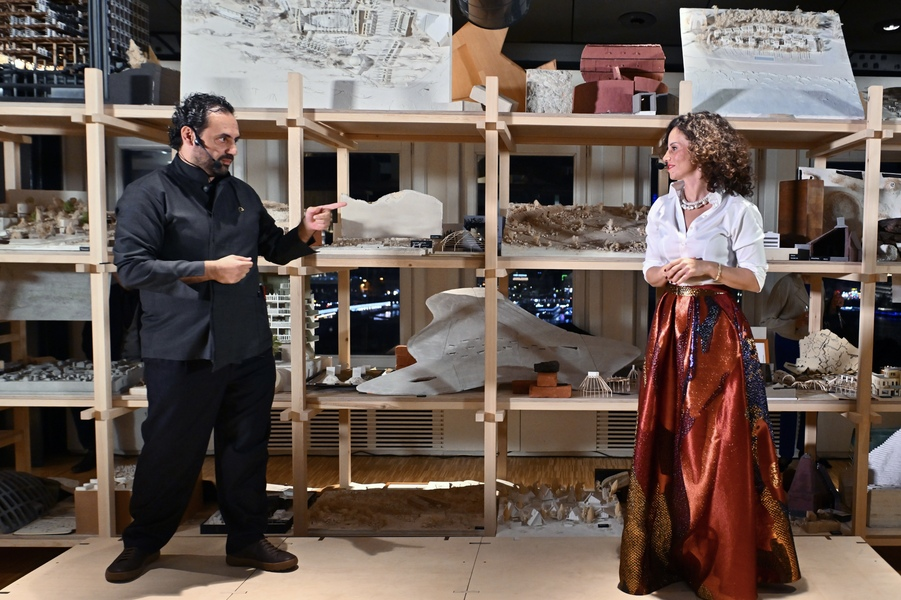
How did the journey of this book begin?
Ömer Selçuk Baz: The concept of creating a book had been circulating within our office for quite some time. However, we consistently postponed it, telling ourselves, “Let’s produce more; the timing isn’t right yet.” Eventually, I realized that this cycle would never end. While we were focused on finishing one project after another, nearly 20 years had slipped by. Most firms engaged in operational architecture like ours rarely find the time to pause, let alone step back from the daily grind. We often fall into the trap of thinking our only responsibility is the act of architecture itself and the coordination of its production. In reality, articulating what we do is just as vital.
For instance, that communication is exactly what brought us together today. It isn’t realistic to expect someone outside the discipline to suddenly develop an interest in architecture without a bridge. Many people in Turkey are doing incredible work, and sharing those efforts benefits and inspires others. Seeing someone—regardless of their field—achieving something meaningful gives me hope and makes me feel that, despite the challenges of living in a difficult country like Turkey, good things are still possible. We wanted our work to be known so that others could share in that feeling. It’s not about claiming everything we do is flawless; it’s about the fact that we are trying.
The second motivation was the desire to view our own output from a distance. I invited Banu to collaborate on this because we’ve known each other through architectural circles for 15 or 16 years, yet we occupy different spheres of the profession. While we run a medium-sized design office, Banu’s role is harder to pigeonhole—she has her hand in many architectural productions and dialogues. Most importantly, she is a gifted writer. I’ve always admired the sincere tone in her work; conveying genuine emotion through text is no easy feat. In both my professional and personal life, I gravitate toward people whose company I enjoy—those who understand us while remaining firmly themselves. Banu was the right choice for this journey.
Banu Uçak: Although I studied architecture, I only worked as a designer for a very brief period. Instead, I moved into the more culture-oriented side of the profession, gaining significant experience at the Building Industry Center before transitioning into the materials and real estate sectors. Throughout this time, I stayed connected to intellectual production through teaching, writing, speaking, and judging competitions. What has now become part of my professional life was, for a long time, my hobby. I simply love thinking and writing about architecture. It moves me deeply because it is a field where human will, intelligence, and potential are so visible. I have immense admiration for human performance and the way our essence takes shape through talent.
When this book was proposed, Selçuk invited me to collaborate. While I understood his motivations, I had to ask myself: Is this something I want to do, and can I actually do it? Passion for architecture doesn’t automatically translate to a passion for every single structure a specific office produces. To be realistic: no, it doesn’t. Therefore, I wanted the book to allow for a critical distance—a space where I could express my honest thoughts and use Yalın Architecture’s 20-year history as a foundation for broader architectural debates. We decided to move forward with that shared understanding.
I have formulated the following questions based on the remarkable projects featured in the book, including a brief context for each design. Enjoy the read.
CAPPADOCIA REGIONAL MUSEUM
“The narrative of the Cappadocia Regional Museum is rooted in the regional tradition of life embedded within rock. Located in an existing quarry, the museum clears only enough space to facilitate circulation. Its reception structure is further integrated into the site, constructed using stones extracted directly from a quarry established on the property.”
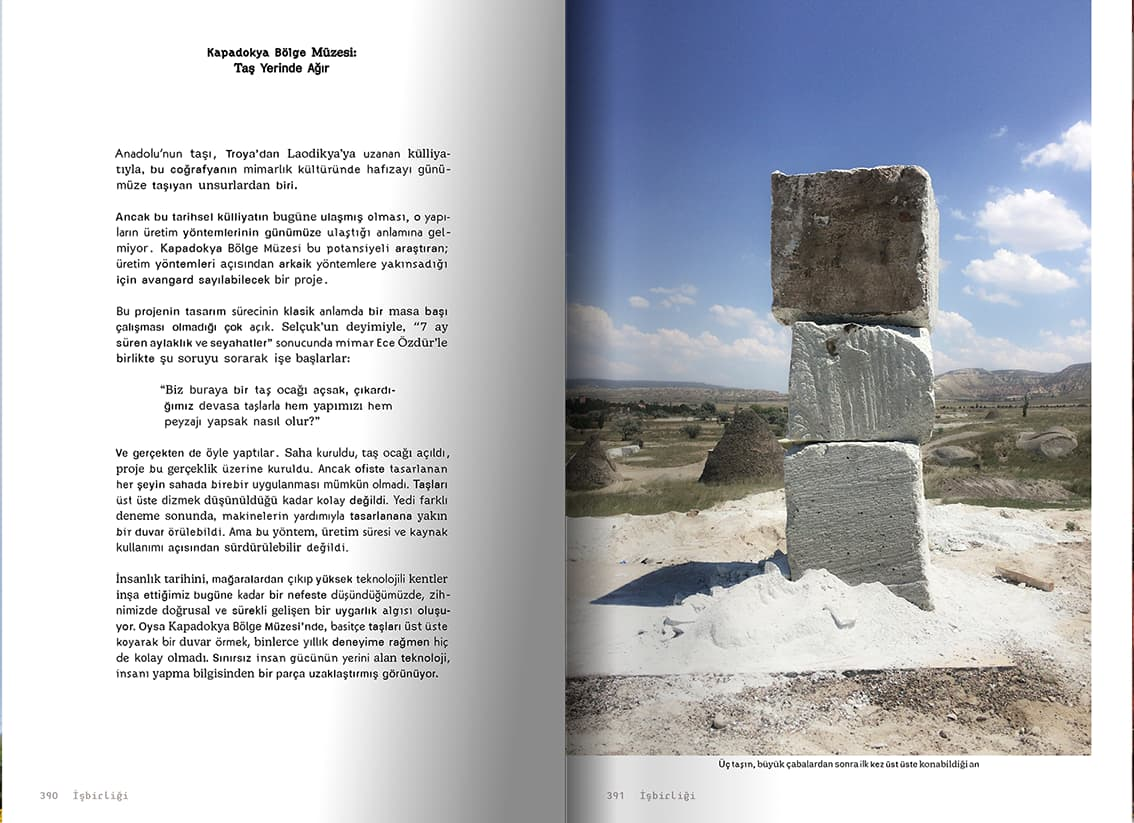
The Cappadocia Regional Museum is quite an original structure. You’ve mentioned that the circulation decisions here differ from standard practices. Could you define what “circulation” means in this context?
Ömer Selçuk Baz: For any museum or visitor center, the foundational methodology is planning the visitor’s movement. When you are designing an atmosphere or an experience-focused space, that movement can be either very fluid or very strictly defined. Circulation design is essentially determining where a visitor enters, how they navigate the interior at any given moment, and where they encounter specific experiences. In a sense, we are creating a form of sensory manipulation. We might surround the visitor, then open the space up, or lead them into a brightly lit area. You can view these sequences of spaces almost like a film with a predetermined narrative arc.
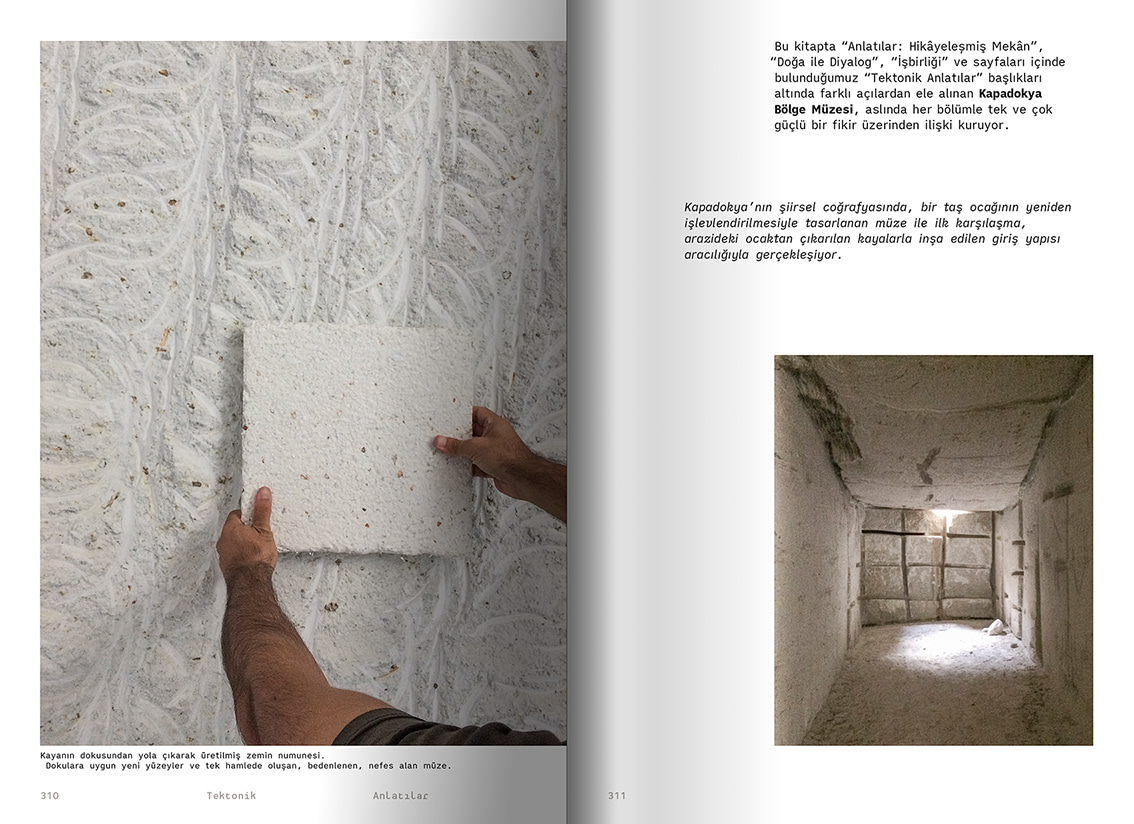
Ms. Banu, in the book, you described the design for this museum as being simultaneously “impossible” and “entirely reasonable.” Why is that?
Banu Uçak: In this case, no traditional building is being “constructed” for the museum. There was an abandoned quarry where stone extraction had already created a labyrinth-like void. My colleagues looked at this “fingerprint” left in the earth and suggested, “We can have people walk through this.” It’s like Ariadne’s thread—they mapped out a trail and a visitor experience within the existing void.
Now, from an employer’s perspective, if someone said, “You don’t need to dig foundations or build walls; I’ll just go into the quarry and turn it into a museum,” it sounds both incredibly logical and utterly impossible. A quarry is a natural formation already manipulated by human hands, so the idea is very raw. Initially, you think, “This simply has to happen.” But then you have to solve for ventilation, safety, and technical requirements—that’s where the “impossible” part comes in. Contemporary architectural knowledge often moves us away from these primal solutions, yet centuries ago, settling in a cave was perfectly reasonable. This project returns to that miraculous, simple logic.
KONYA CITY LIBRARY
“The library, composed almost entirely of single-story structures, is nestled among the trees, maintaining the continuity of the park. This fragmented design results in a permeable form that actively engages with urban life. Despite the necessary security and access controls, the architectural organization provides an experience that closely mirrors a truly public space.”
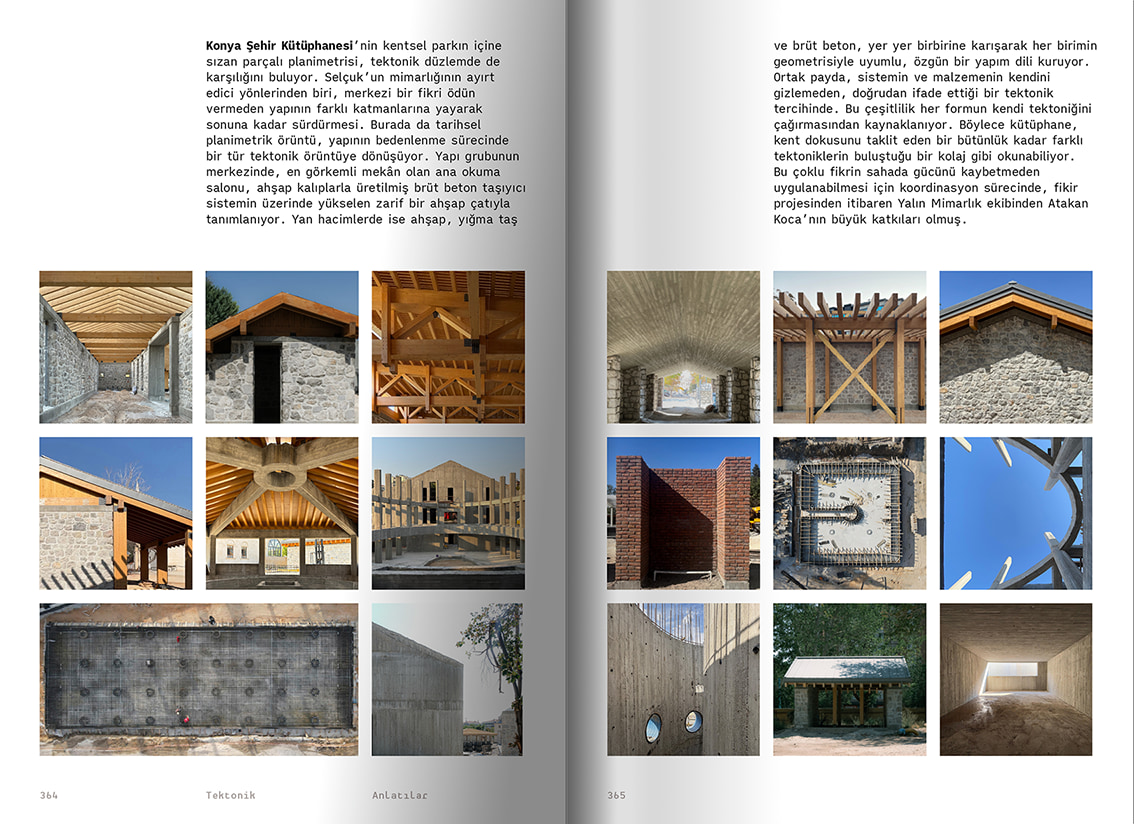
You previously designed a library for Boğaziçi University that was never realized, and now you have the Konya City Library project. How do these two designs differ?
Ömer Selçuk Baz: The two projects exist in entirely different contexts. One was a super-compact design for a university campus, whereas the other is a city library in Konya, situated in the heart of a park on the site of a former municipal building. The city library offers a “plural universe,” with various rooms acting as its “eyes.” In many ways, they sit at opposite ends of the architectural spectrum.
The Boğaziçi project was a study in density and concentration across multiple floors. In contrast, the Konya project is as scattered as possible; it consists of single-story buildings with diverse reading rooms accessible directly from the park, each speaking a different architectural language. It offers visitors a unique experience every time—a different room, a different level of focus, and a different atmosphere, spanning both open-air and enclosed spaces. Construction is currently ongoing, and it is expected to open toward the end of this year.
ZONGULDAK CAVES VISITOR CENTER
“Designed for the Gökgöl Cave in Zonguldak, this visitor center acts as a gateway to a three-million-year-old natural formation, making the inherent tension between nature and humanity visible. The contrasts between interior and exterior, light and dark, and the natural and the artificial serve as narrative tools to construct this spatial tension.”
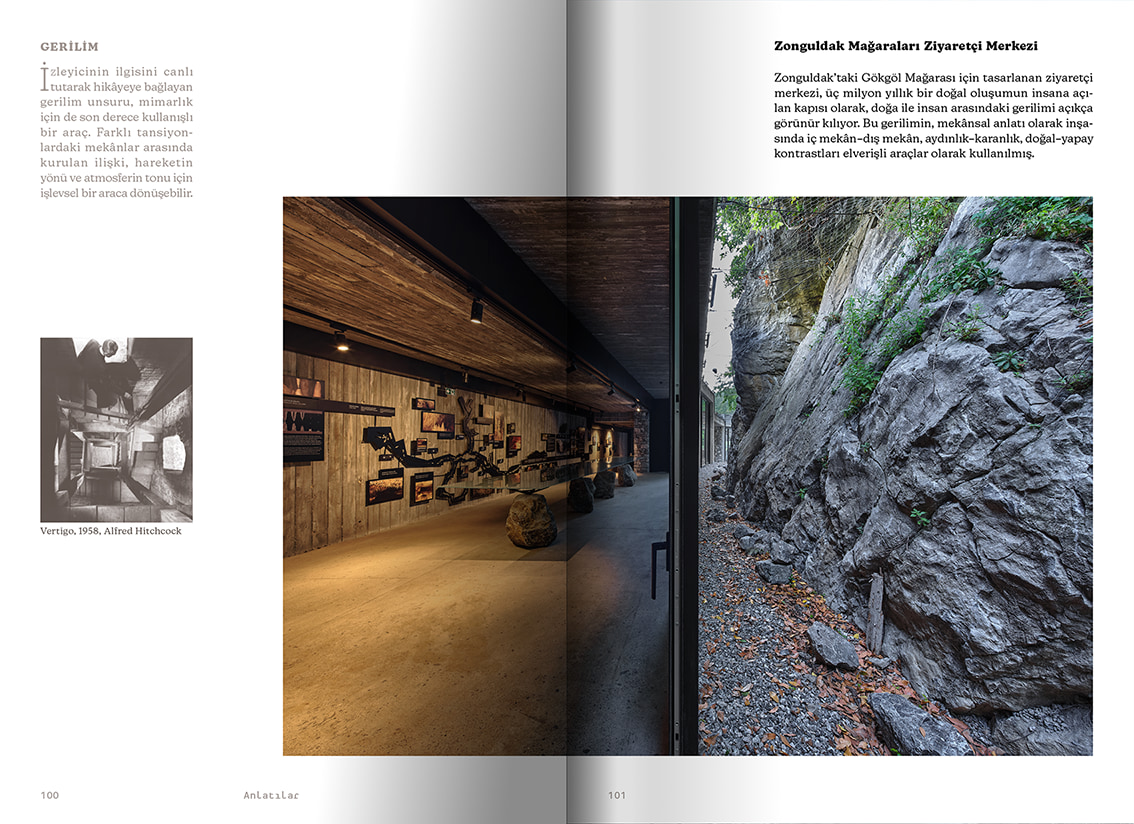
The Zonguldak Caves Visitor Center harmonizes with nature and creates a profound sensory impact. However, in the book, you also expressed sadness regarding certain elements that went awry after the project was completed. Could you elaborate on that?
Banu Uçak: I find it incredibly impressive that humanity has found a way to intervene in a geological formation millions of years old. The cave there is roughly five to six million years old, and this structure is one of those works that highlights the “illusion” and power of architecture. It leans naturally against the mountain, making everything feel as though it fits perfectly. Yet, to achieve this, you must seriously manipulate and “tame” that piece of nature.
The structure is built from local stone, looking as if it inherently belongs there, drawing visitors into the space. I used a Hitchcockian analogy in the book because there is a palpable tension; for instance, you might approach a wall but find you cannot quite touch it. It’s a design that triggers and plays with our more archaic feelings.
On the other hand, there is the reality of “operation” in Turkey. In that high-tension space I described, there is now—if I recall correctly—a soda refrigerator. Unfortunately, the building no longer looks as pristine as it did in the initial photographs. We see this often; one might say “the public doesn’t understand,” but the truth is that life eventually fills every void. We must ask: As architects, could we have designed against this from the start? It is a discussion that needs to stay open.
Ömer Selçuk Baz: I actually sent Banu photos of the current state of the space and encouraged her to use them. In our field, architecture is often presented as a tale of heroism, as if the architect has executed everything perfectly. In a book like this, the author’s critique is directed at both the client and the architect. It asks: “Could the architect have taken precautions? Could we have foreseen this?” I believe that architecture cannot exist in a vacuum, ignoring geography, the client, or sociology. Architecture isn’t like cinema, literature, or poetry. A magnificent poem by Edip Cansever remains the same in the 70s as it was in the 60s. Architecture is fundamentally different; it is a living entity that people inhabit and transform according to their own needs.
MANİSA LIBERATION MUSEUM
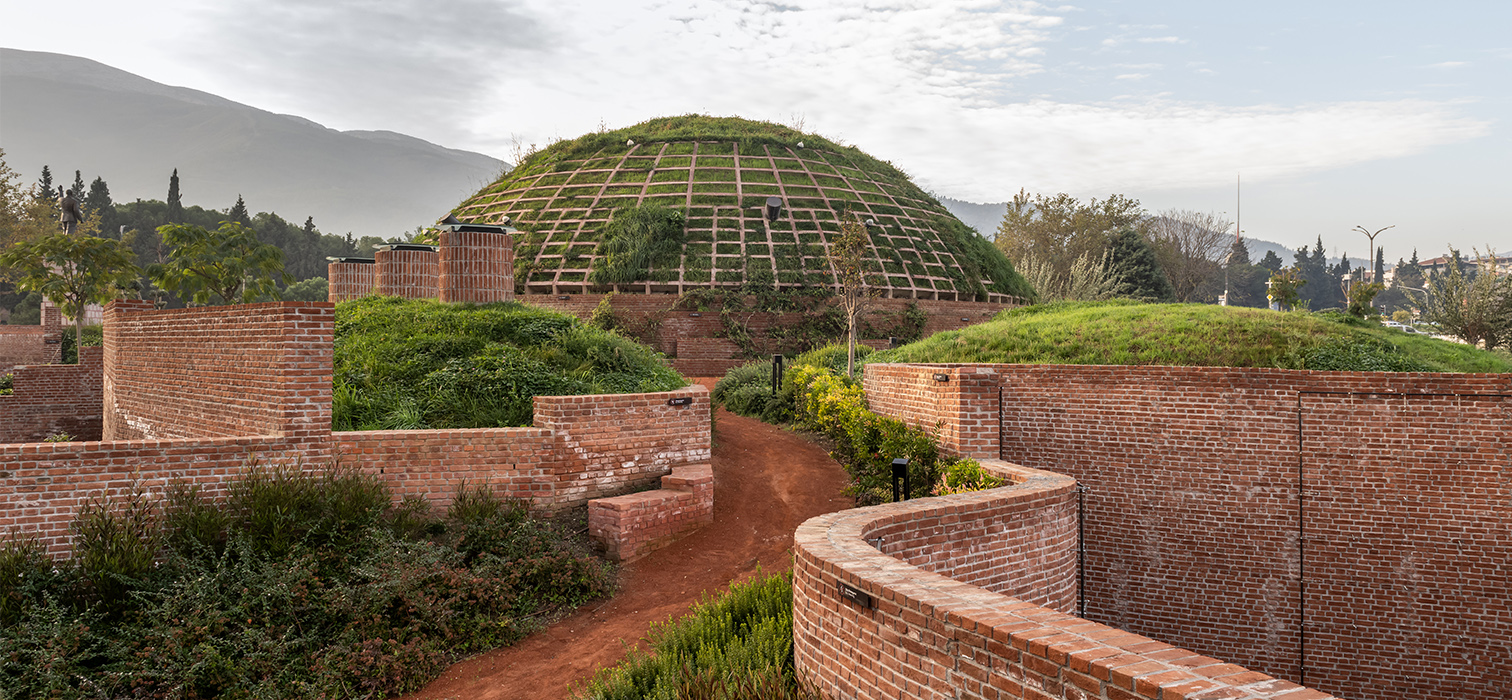
“Designed to revive the memory of rebellion, fear, loss, courage, and rebirth—themes that are not yet fully integrated into the cultural memory—the Manisa Liberation Museum spatializes its narrative chronologically. The movement within is strictly defined by the architecture itself.”
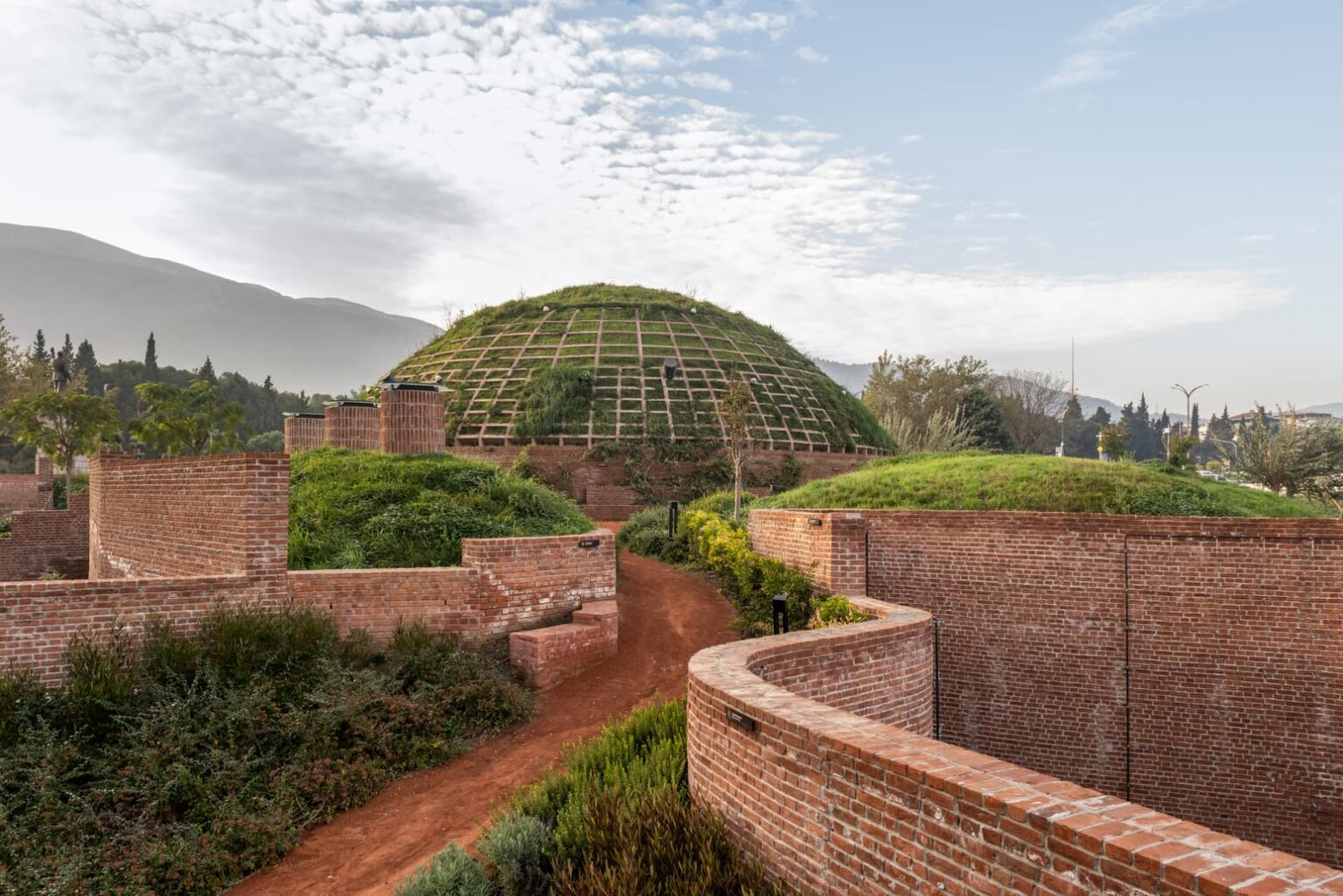
The use of brick in the Manisa Liberation Museum is visually striking, yet the book suggests it was a difficult material to work with. What is your perspective on this?
Banu Uçak: Several aspects of this museum are deeply impressive. It tells the story of Manisa’s liberation, yet due to the nature of that history, there is very little material evidence or physical artifacts to display. How do you exhibit the experience of a people who fled to Spil Mountain, watched their city burn for three days, and lost everything? The museum solves this by telling the story through space and atmosphere—a form of spatial symbolism. While symbolism is natural in poetry, in architecture, it is risky; if executed poorly, it can feel garish or hollow. I find this “avant-garde” experiment very successful.
Furthermore, the museum avoids the trap of easy heroism, instead focusing on the existential state of the human condition. Regarding the bricks: the ancient city of Sardis is nearby. This region has a tradition of masonry that dates back to the Lydians—the people who invented coinage. Reinvigorating the use of brick, which was used so masterfully in these lands centuries ago, is a vital way of reclaiming a local identity.
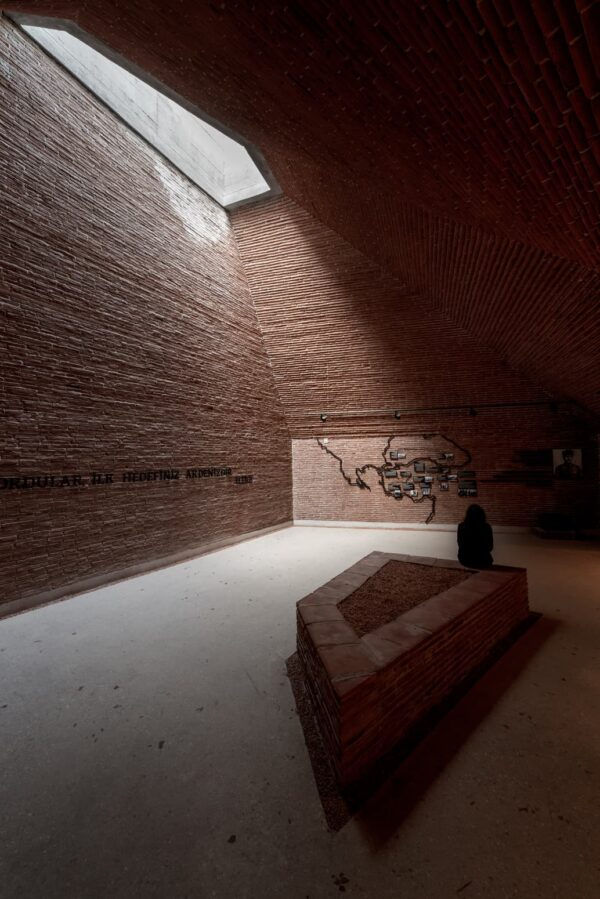
Ömer Selçuk Baz: Brick is indeed central to the region’s DNA. In Manisa, particularly during the early Ottoman and Beylik periods, buildings were often composite structures of stone and brick. The Great Fire of 1922 destroyed almost all of them. Since the museum is largely an underground structure topped by a park, we chose brick for its tectonic strength and its raw, material presence. It was a beautiful puzzle for us, but a difficult one. As a society, we’ve actually “forgotten” how to build like this. It’s like trying to write a letter by hand after twenty years of typing; your muscles and memory have faded. If we can forget how to fold a letter in two decades, imagine what we lose over 500 years of moving away from traditional masonry. This building was an effort to bridge that gap.
TROY MUSEUM
“The richness of the Troy Museum lies in its simplicity. It clearly defines the visitor’s journey without being entirely closed off, allowing the experience of Troy to remain inseparable from its geographical context.”
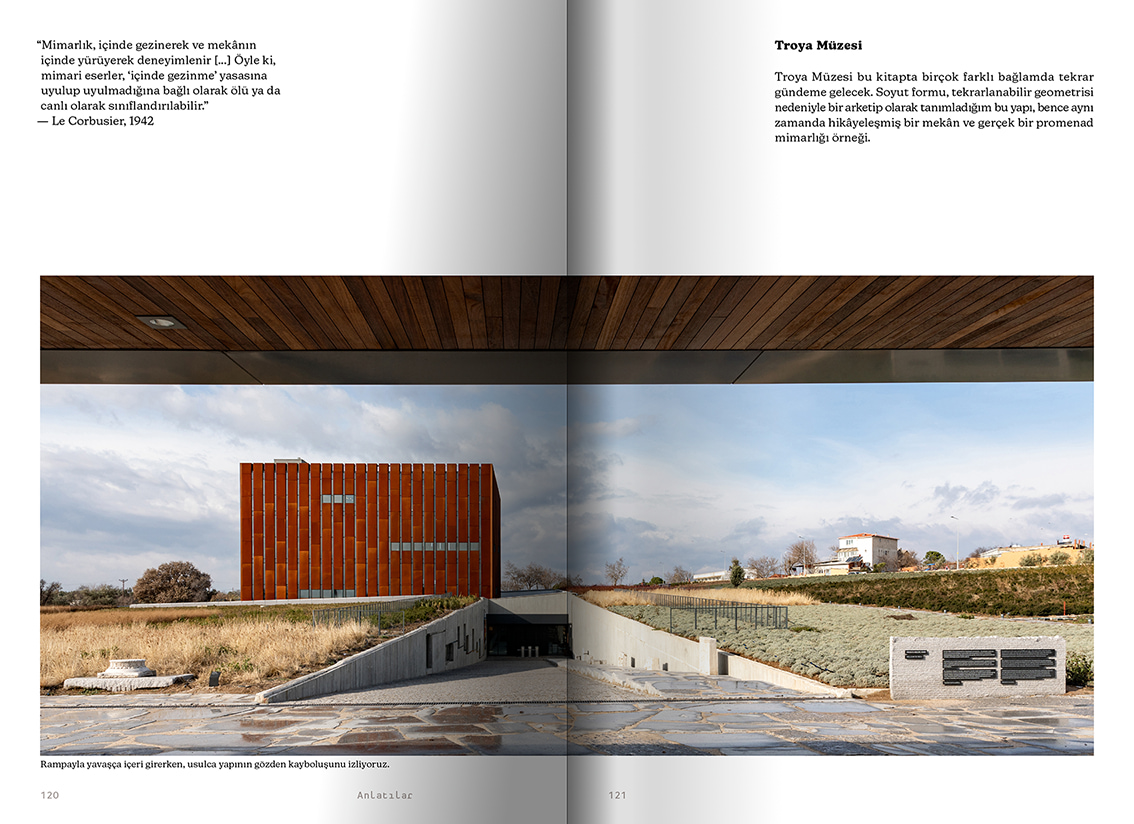
While the Manisa museum blends into the earth, the Troy Museum stands as a singular, imposing object in an open landscape. To a layperson, it almost resembles the Trojan Horse. Was that a conscious design choice?
Ömer Selçuk Baz: That is a very valid interpretation. What I love most about this work is that its abstraction allows for such diverse readings. During the competition phase, a jury member looked at the design and said he saw the Trojan Horse, with Achaean soldiers peeking out of the windows toward the Trojan citadel. It hadn’t crossed my mind at all, but the building creates that kind of imaginative void. Others have compared it to an object fallen from space, a cold storage facility, or something pulled up from deep underground. The beauty is that visitors cannot remain indifferent to it. Ultimately, the system was designed from the inside out; the interior requirements dictated the exterior form. We are less concerned with “look” and more concerned with function and construction logic. We accept the aesthetic that the construction process naturally produces.
KONYA TEKEL BUILDING – WAREHOUSE NO:4
“Throughout the design process, the primary objective was to adapt the building to contemporary needs with a flexible approach while meticulously preserving its historical layers. The final result reflects a philosophy that avoids the ‘polished’ or ‘perfectly finished’ look. Instead, it makes the traces of time visible, internalizes the building’s lived history, and finds an aesthetic value in imperfection.”
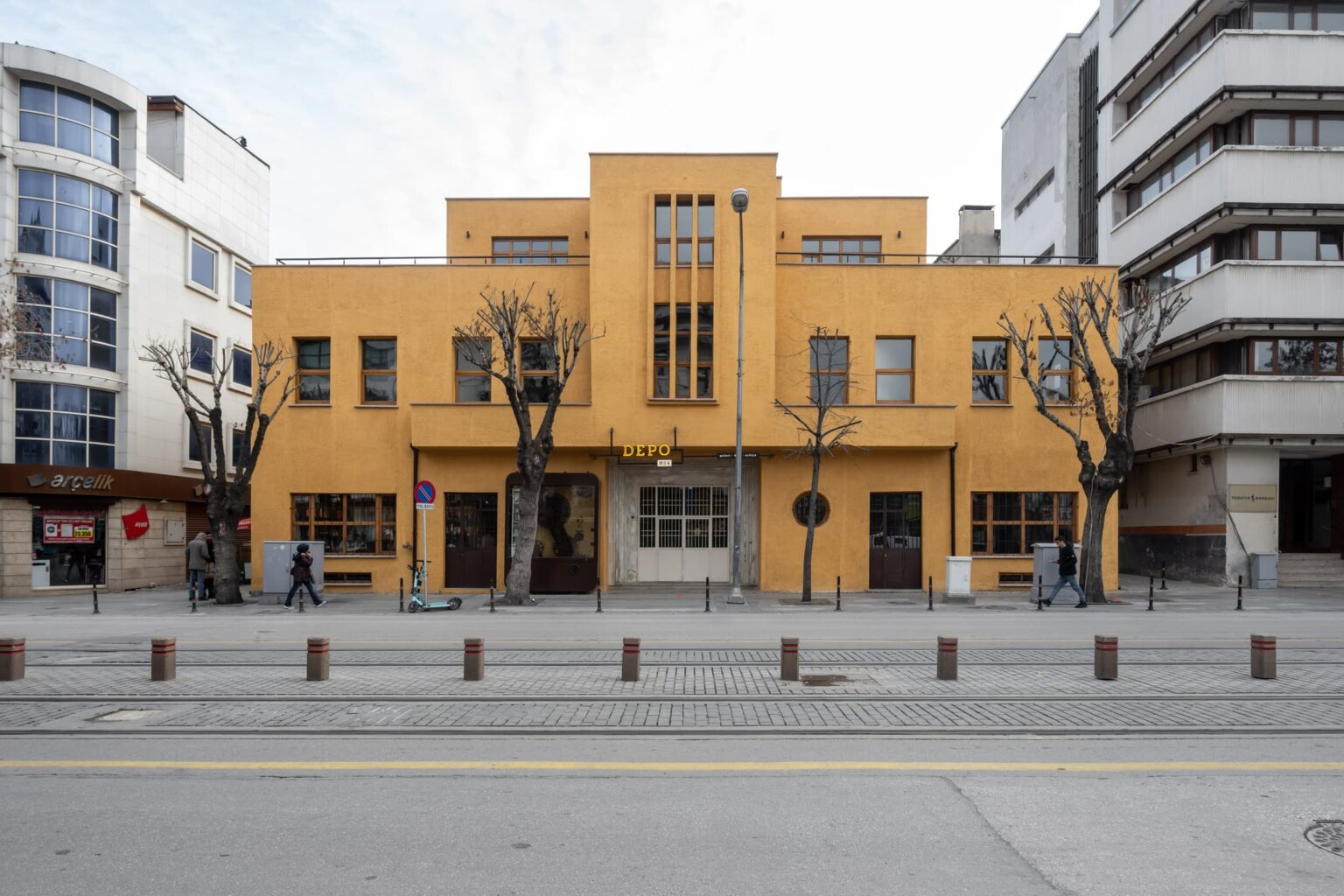
You took on the challenge of repurposing this 1935 structure—originally a warehouse and office for Tekel—into a modern art gallery. Turkey is home to many such Republican-era buildings that hold a significant place in urban memory. What are your thoughts on their preservation?
Banu Uçak: This is a subject of intense global debate often referred to as “industrial archaeology.” Most of these structures, born of the Industrial Revolution, now occupy prime locations in city centers worldwide, making them incredibly valuable pieces of real estate. This particular warehouse sits in the heart of Konya, making it an ideal candidate for public and artistic use. Naturally, there is always a push from industry to demolish these older sites in favor of something brand new. However, in Konya, there is a deep community connection; many residents have parents or grandparents who once worked within these walls. These buildings represent a state-led industrialization drive intended to uplift the entire population. Therefore, the goal is to return these spaces to the public. Selçuk’s team achieved this by preserving every historical layer, allowing us to feel the building’s age. They’ve gifted us a space where the “spirits” of the 1930s, 50s, and 70s remain present—evident in the rasped walls, the deliberate “unfinished” spaces, the matte coatings, and even the custom-designed details in the restrooms. It is a triumph of sensitive design.
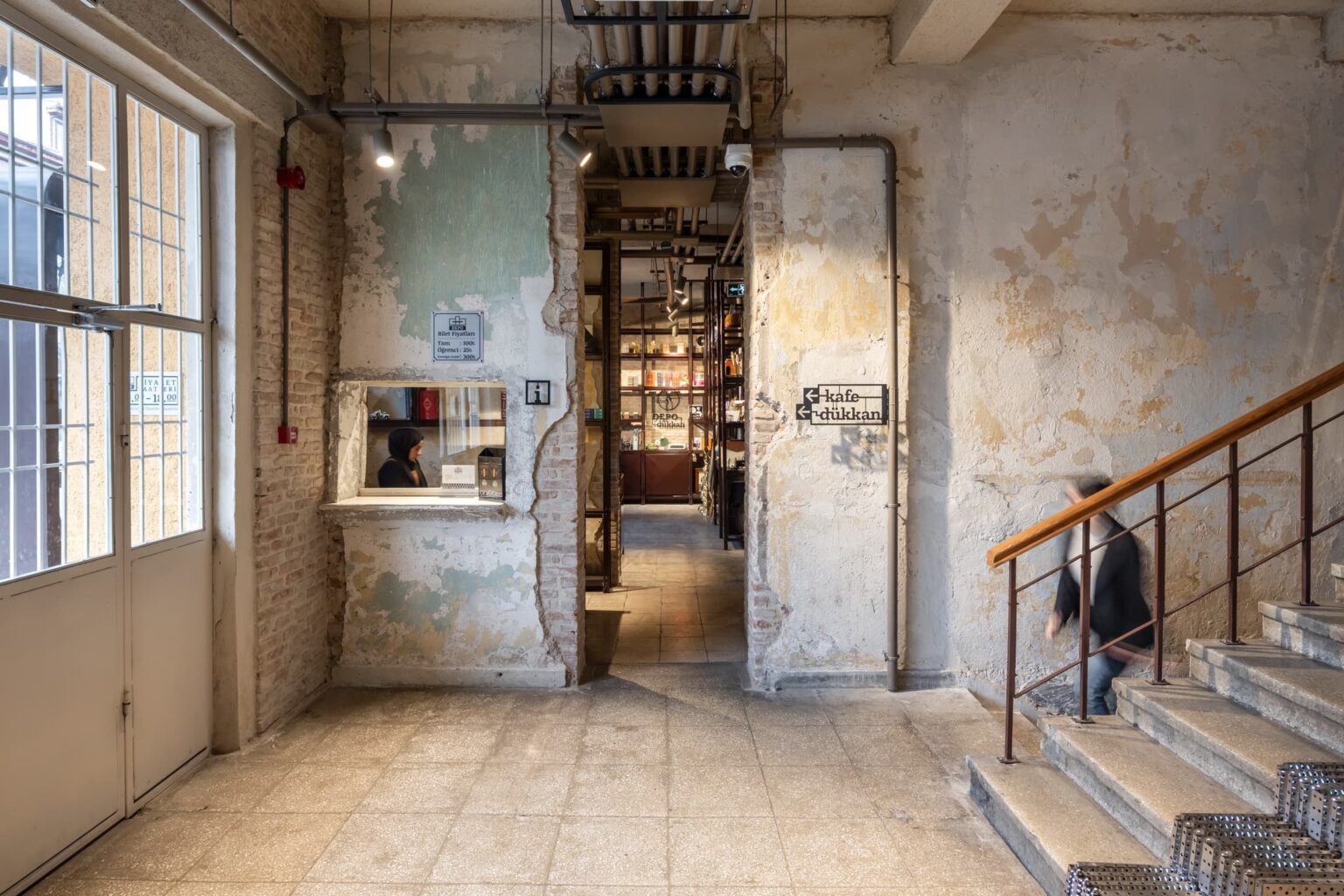
Ömer Selçuk Baz: In Turkey, this is a complex issue. I understand the difficulties from a decision-making standpoint, and it’s important to acknowledge that the preservation of this building was made possible by the Konya Metropolitan Municipality. Architects cannot carry this burden alone. Of course, our stance is always to “preserve.” A city cannot be in a constant state of demolition and reconstruction; it needs its memory. Sometimes, there is even strategic value in keeping a building that might be considered “ugly.” The 1935 Tekel Warehouse is a charming, small-scale period building located in a vital part of the city. When a local government proposes converting such a space into a flexible gallery, it is our duty to support it. These structures possess a level of character and specialized features that are nearly impossible to replicate today. While I am not a restoration architect by trade and we collaborate with experts on these projects, I find the craftsmanship of the early Republican era deeply impressive.
Banu Uçak: While filming the documentary İzdüşüm (Projection) for TRT, which focused on Ankara modernism, I noticed that the people who use these buildings are often acutely aware of their superior architectural features and take great pride in them. For example, at the İsmet Paşa Girls’ Institute, I saw double-glazed windows nearly 4.5 meters high that still function perfectly—a feat that would be technically challenging for today’s construction industry. There were original heating systems still in operation after decades. The joinery, railings, and balustrades were all handcrafted; they are true works of artisan skill that deserve to be celebrated and kept alive.
06/02 EARTHQUAKE MUSEUM AND THE “OPEN WOUND”
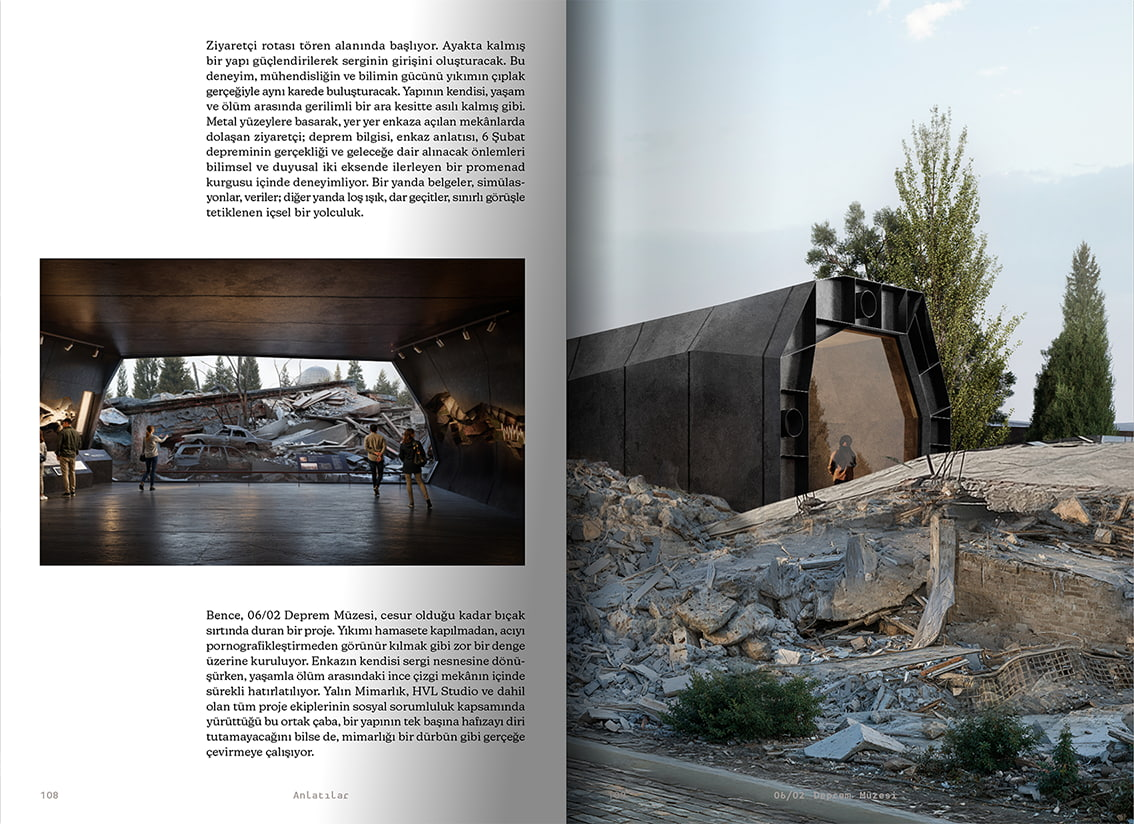
“The most arresting feature of this project is its placement in the heart of an authentic ruin. Just two weeks after the disaster, a cluster of buildings where no lives were lost was selected as the site with the backing of the Gaziantep Metropolitan Municipality. Maintained exactly as it was found—complete with vehicles trapped beneath and personal belongings inside—this site has been transformed into a frozen slice of time, serving as the narrative’s primary foundation.”
What considerations did you have to weigh when designing the Earthquake Museum? Transforming debris into a permanent, public object is an incredibly sensitive undertaking…
Ömer Selçuk Baz: It is an incredibly sharp and delicate matter. We, as the decision-makers, were directly involved in the process of identifying the specific rubble and deciding to build on that exact spot. I arrived on the scene only 15 to 20 days after the earthquake. To be honest, I cannot claim that I was making a purely rational choice at the time; my mind simply wasn’t in the right place for that. Our priority was to select a debris site where there had been no casualties. We also aimed for a location that was logistically close to the city center. Often, such complex plans fail to materialize, but the Gaziantep Metropolitan Municipality fully embraced these decisions and proceeded to expropriate the land. Today, if you travel through any of the 11 provinces affected by the earthquake, you will find almost no remaining debris. This project is nearly the only exception; elsewhere, everything was erased with startling speed. Many other municipalities in the region attempted to preserve a site to tell a story, but none were successful. It is a difficult path to take because society has a natural urge to forget. Everyone wants to shed this heavy feeling as quickly as possible. While forgetting can be a healthy human trait, when it reaches the level of total ignorance, we doom ourselves to repeat the same history. Therefore, I believe the most vital function of this work is pedagogical, specifically for children and young people. It seeks to foster a level of awareness and consciousness regarding why this happened. Yes, you are looking at actual earthquake debris. It will be painful. But I do not believe we can progress by simply looking away. This is a scientific and educational effort designed to confront us with our mistakes and offer insights into how we can build a better future. Our intention was to create a narrative space that incorporates geological layers and speaks specifically to the unique character of that location.
Ömer Selçuk Baz: At the end of the book, you included a section titled “Open Wound,” penned by you, Selçuk Bey, which reflects on the February 6 earthquake. What does this “open wound” represent for you?
Ömer Selçuk Baz: People frequently view the earthquake through a narrow lens, as if we simply experienced a “construction-related disaster.” I believe this is a deeply flawed perspective. Whatever we are as individuals and as a collective society is inevitably mirrored in our built environment. It is a grave error to interpret these events as something separate from us. To me, the earthquake revealed that we are living with a profound systemic issue; it showed us how easily the social, administrative, and urban structures of a city can be shattered. As someone from Antakya, I personally lost many people close to me. Setting the emotional weight aside for a moment, what affects me even more deeply is the realization that this was a massive social collapse—a litmus test for a pervasive state of decay. The earthquake was the most significant turning point of my life. It opened a vast wound within me. I began to consider how to use my limited energy, and I told myself: “If I feel this way, I must speak about it and share it.” I have to explain that this deformation isn’t just about concrete and construction; we are in the middle of a much larger social breakdown. For the first 15 months, I spoke about this wherever I went. Eventually, I began to integrate this mission into my professional work. I committed myself to projects I felt were necessary: the museum in Nurdağı, a housing initiative in Antakya, and the rehabilitation of the Antakya Archaeology Museum. I try to contribute whatever my life energy permits. I want to conclude just as I did in the book: if I don’t dedicate myself to this, what purpose would I have as an architect!