Opening in Los Angeles on September 22, the Lucas Museum of Narrative Art turns storytelling into an experience shaped by art, cinema, architecture and landscape.
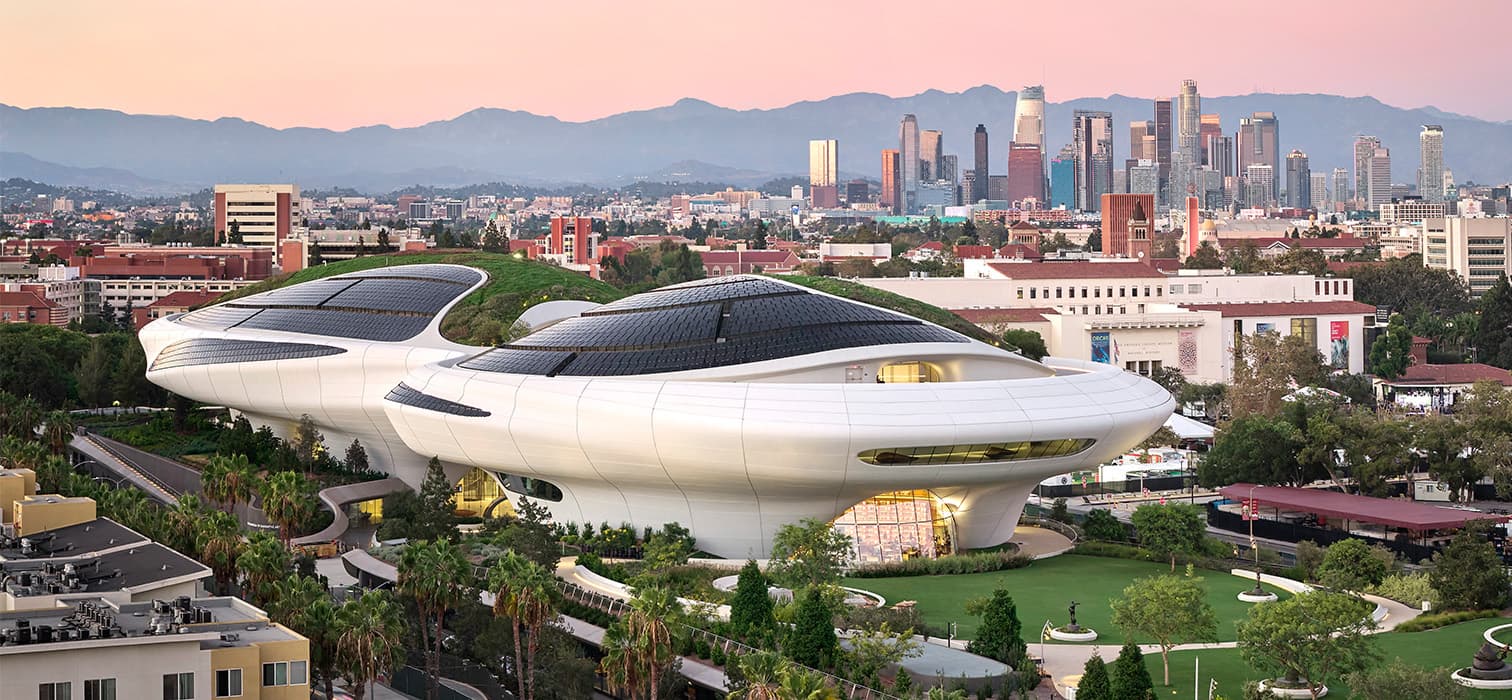
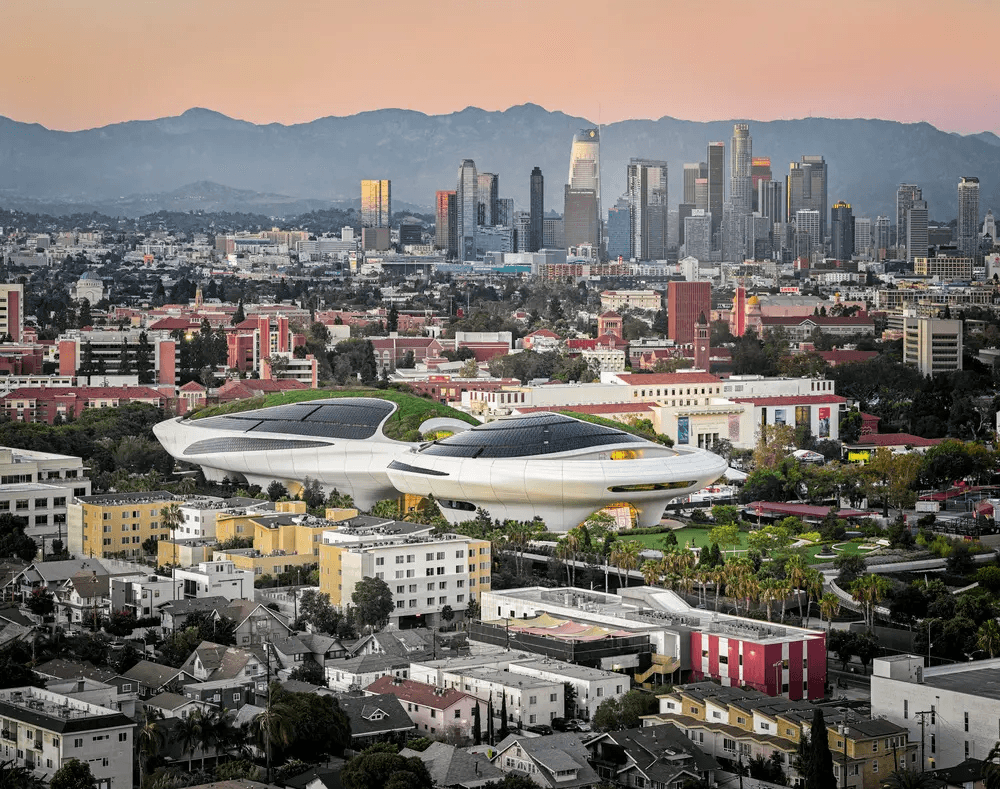
A new cultural landmark is joining Los Angeles’s map — and this time, the story begins long before visitors step through the museum doors. Rising above Exposition Park, a white, curving volume appears almost suspended in the landscape. From some angles it resembles an enormous cloud; from others, a form borrowed from a future we have yet to name. Inside, thousands of years of visual storytelling unfold, from ancient imagery and comics to Norman Rockwell, Frida Kahlo, photography and cinema.
Founded by George Lucas and Mellody Hobson, the Lucas Museum of Narrative Artwill open to the public in Los Angeles on September 22, 2026. Rather than following the traditional classifications of art history, the museum considers painting, illustration, comics, photography, murals and cinema as different expressions of the same narrative impulse.
Spanning approximately 300,000 square feet, the building houses more than 30 galleries and over 100,000 square feet of exhibition space.
Courtesy Lucas Museum Of Narrative Art
Stories Across Time
The premise behind the Lucas Museum begins with a seemingly simple question: Why have humans been telling stories through images for thousands of years?
Its founding collection of more than 40,000 works approaches that question across centuries, disciplines and cultures. More than 1,300 works from the collection will be presented in the opening exhibitions. The fact that names as varied as Vincent van Gogh, Norman Rockwell, Frida Kahlo, Jacob Lawrence, Beatrix Potter, Diego Rivera, Gordon Parks, Charles Schulz and Takashi Murakami can appear under the same roof reflects the museum’s deliberate effort to loosen the conventional hierarchies of art history.
Courtesy Lucas Museum Of Narrative Art. Photo by Iwan Baan
On the first floor, The History of Narrative Art: Heroes • Myths • The Sacred traces storytelling back to myth, sacred narratives and collective memory. Galleries on the upper floors move through themes including love, family, community, adventure and childhood, alongside comics, manga, photography and murals.
Rather than leading visitors through art history as a strictly chronological sequence, the Lucas Museum proposes another route: understanding visual culture through the stories people have told one another for centuries.
Courtesy Lucas Museum Of Narrative Art. Photo by Iwan Baan
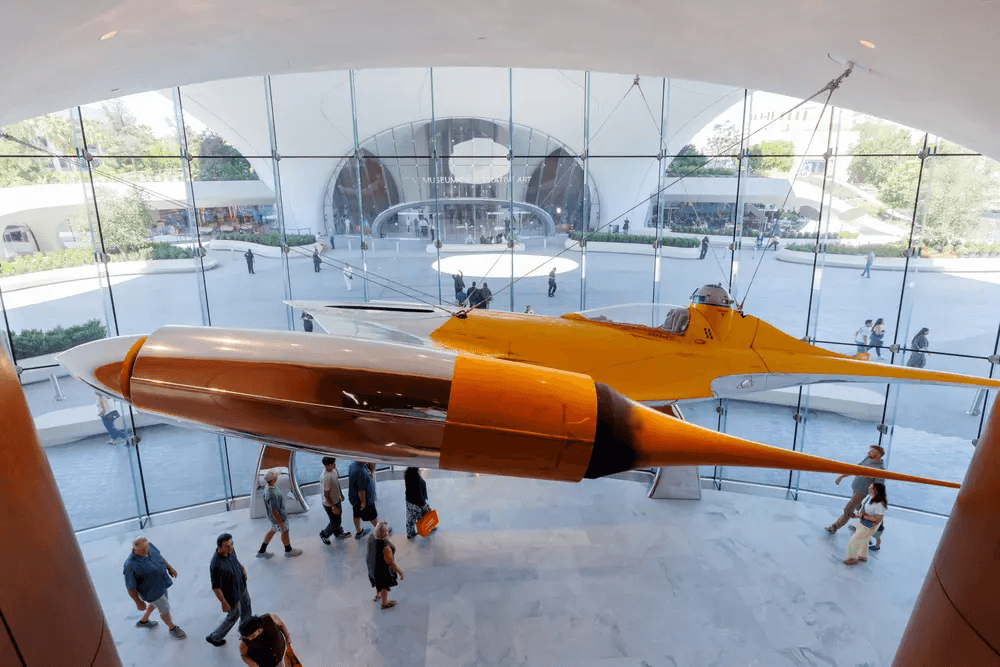
And, inevitably, Star Wars has a place here too. But this is not a “Star Wars museum.” The opening exhibition Star Wars in Motion brings together concept drawings, costumes and vehicle designs from the Lucas Archives through the idea of movement. From Luke Skywalker’s Landspeeder to General Grievous’s Wheel Bike, the exhibition reveals how imagined cinematic worlds move from the drawing board into physical form.
Courtesy Lucas Museum Of Narrative Art. Photo By Iwan Baan
Architecture in Motion
What may ultimately establish the Lucas Museum as one of Los Angeles’s most distinctive cultural destinations is not only what it contains, but the building itself.
The architecture was conceived by Ma Yansong, founder of Beijing-based MAD Architects, in collaboration with Stantec. Rather than designing a monumental museum in the conventional sense, Yansong approached the project as the creation of a new topography within the park.
Courtesy Lucas Museum Of Narrative Art. Photo by Hufton Crow
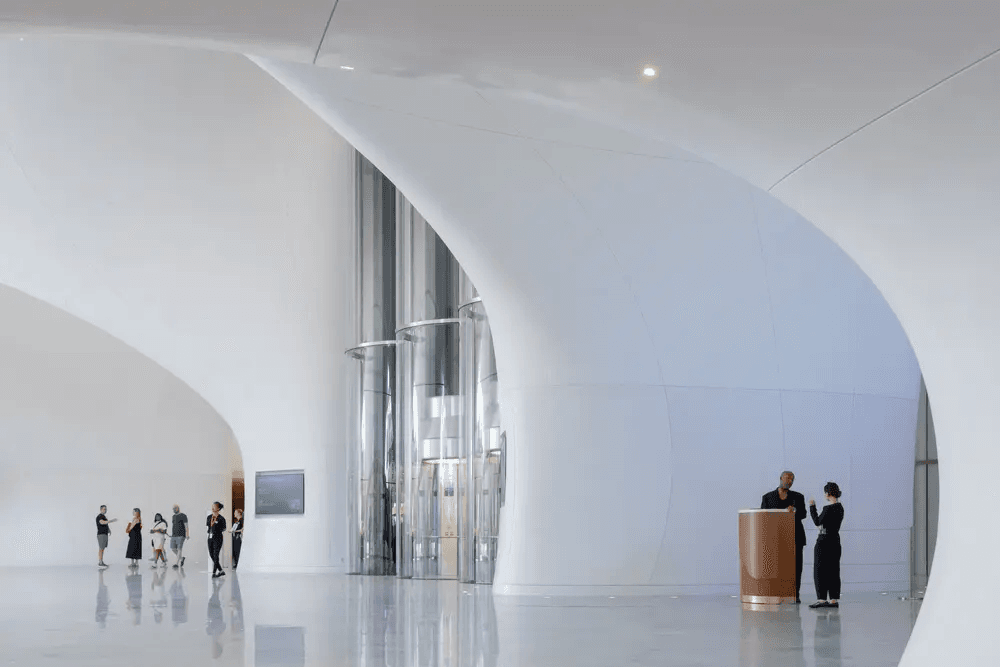
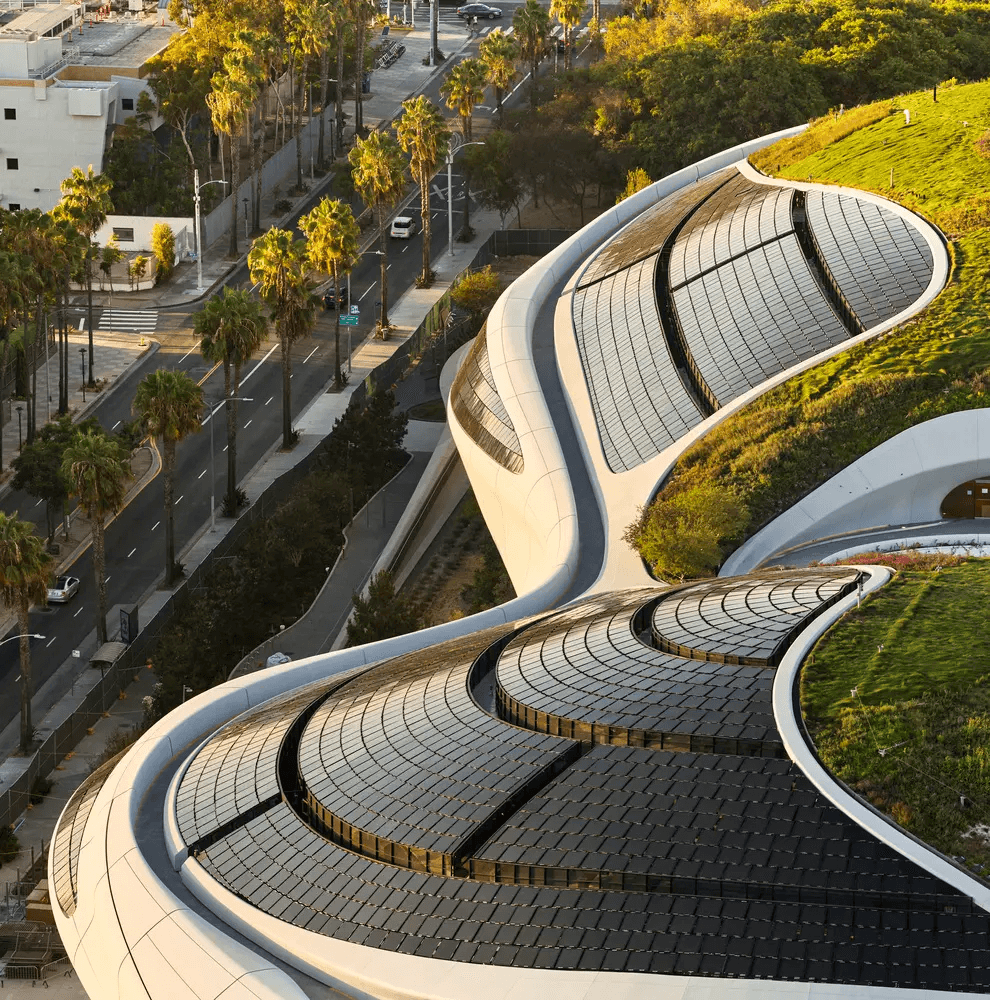
There is not a single straight line in the design. Walls, ceilings and the outer skin curve continuously into one another, deliberately blurring the point at which architecture ends and landscape begins. Yansong has described his intention less as designing a building than creating an “environment” or a “stage.”
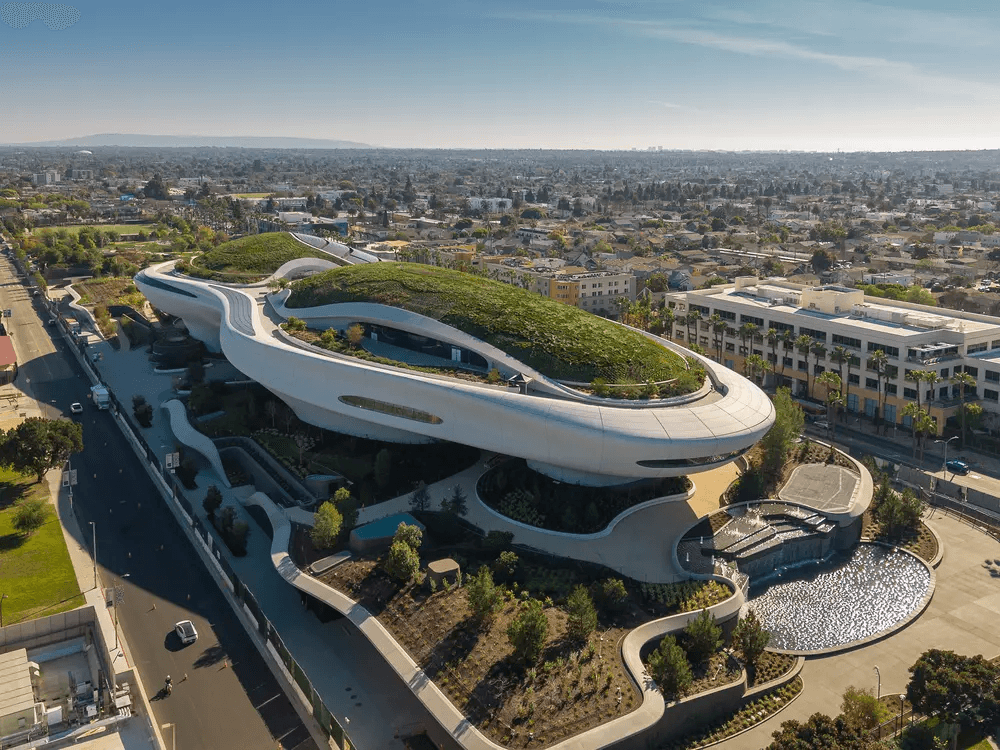
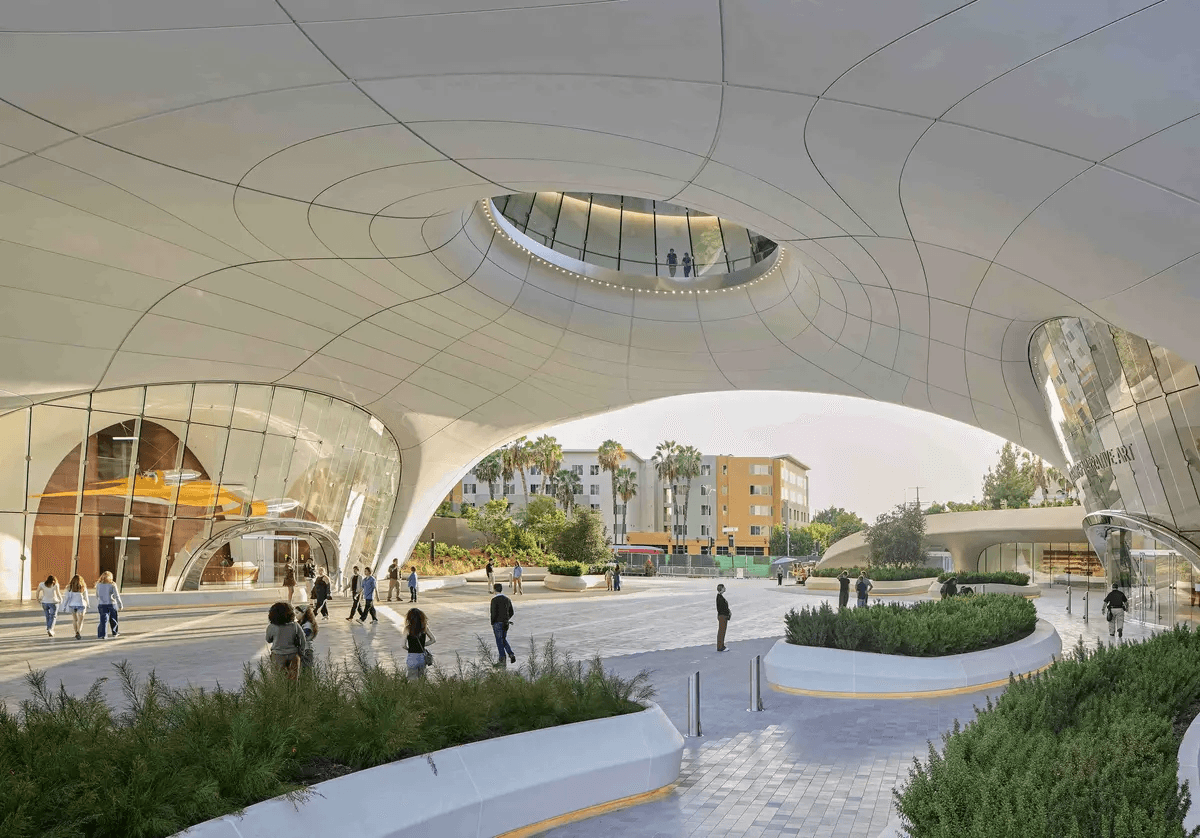
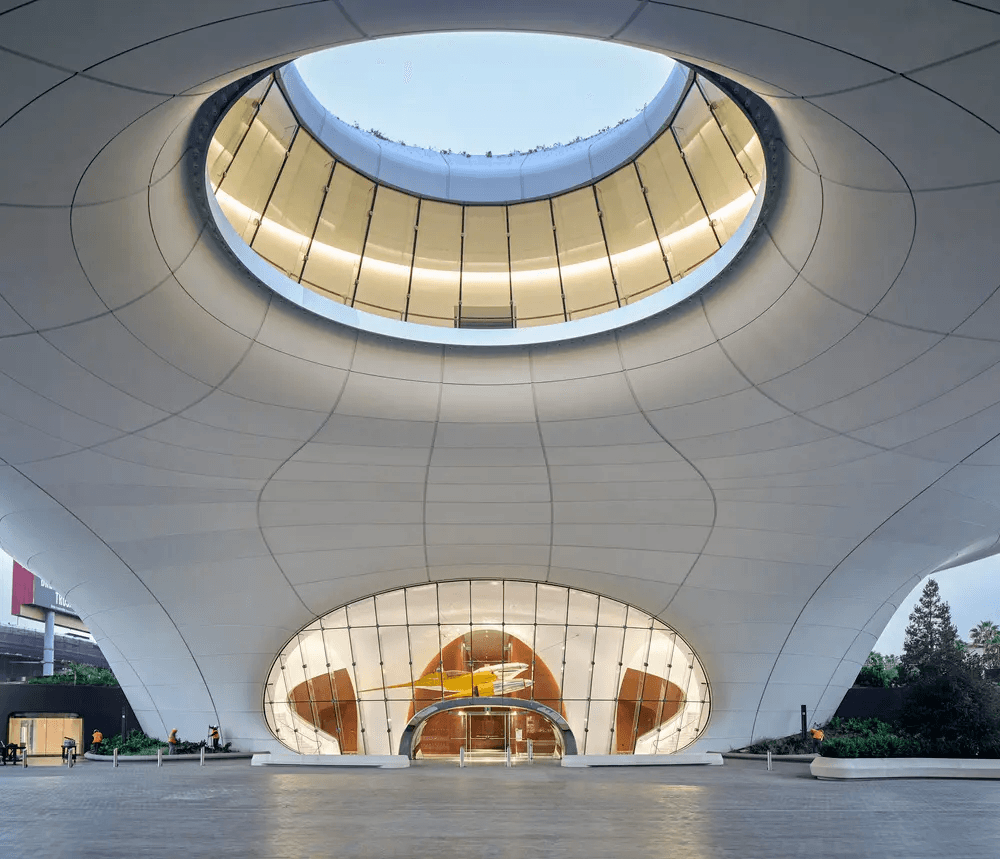
One of the inspirations behind this approach was the canopy formed by the mature trees of Exposition Park. Yansong imagined the building as an artificial yet organic continuation of that natural shelter. As a result, the immense structure does not sit heavily on the ground. It touches the site only at selected points, lifting in the centre to create a public plaza beneath it.
Courtesy Lucas Museum Of Narrative Art. Photo by Hufton Crow
One of the project’s most dramatic engineering gestures is the central arch, which spans approximately 56 metres without intermediate support, connecting the north and south lobbies. Four storeys above, a vast elliptical oculus opens the plaza directly to the sky.
The effect is strikingly cinematic. Even before entering the museum, visitors become part of a carefully composed sequence. Walking beneath the structure, the enormous volume appears to hover overhead; looking up, the oculus turns the sky itself into part of the architecture.
This is particularly significant for a museum dedicated to narrative. Here, storytelling is not confined to the galleries. Architecture itself becomes a narrative device, guiding movement, shifting perceptions of scale and framing individual moments along the visitor’s journey.
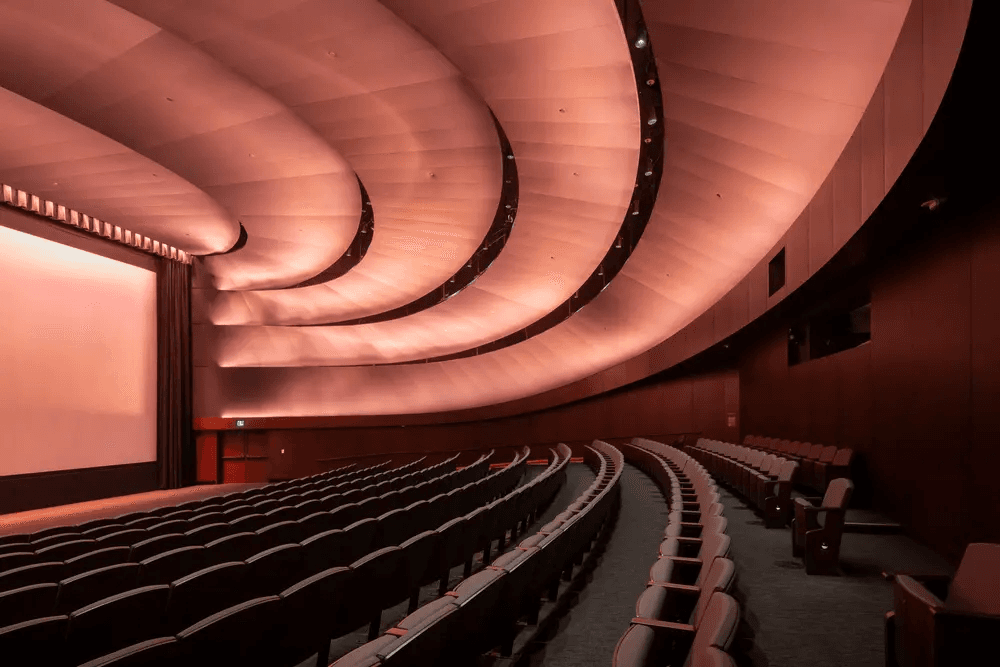
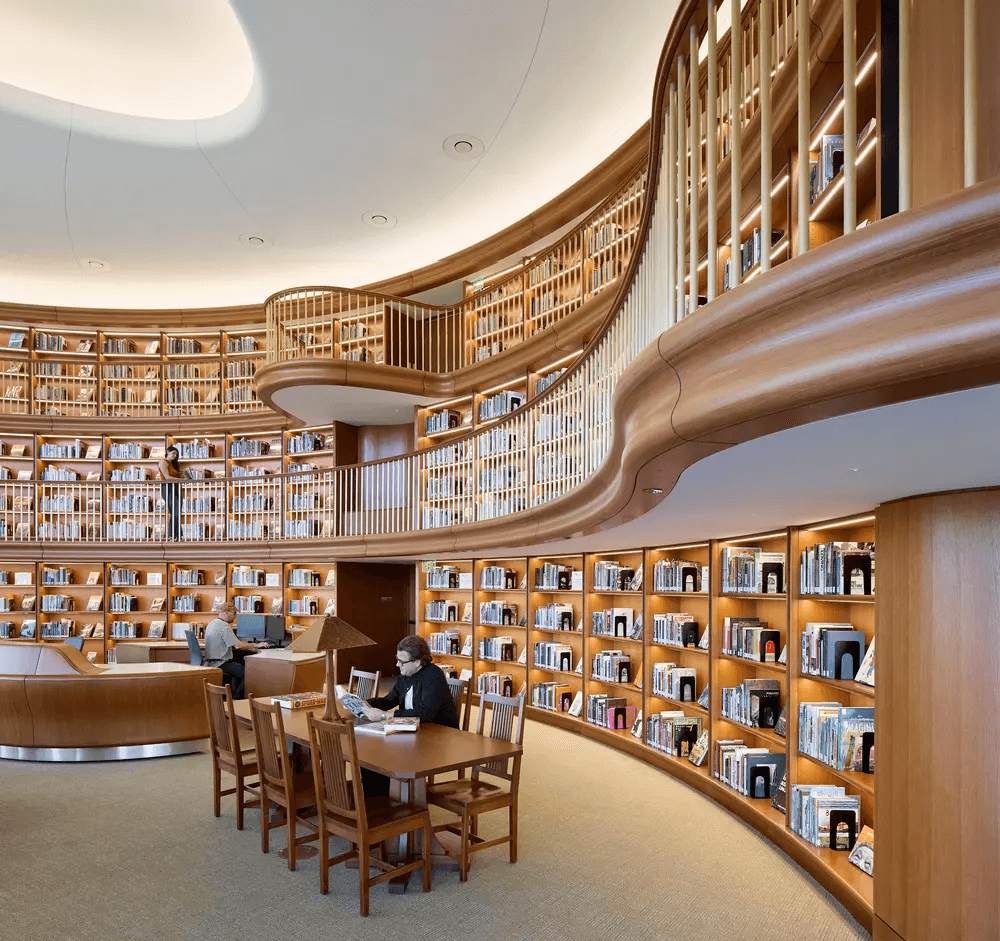
That sense of continuity extends indoors. In addition to two theatres, the museum contains a horseshoe-shaped research library enclosed by floor-to-ceiling windows overlooking the park, 10 studios and classrooms, a shop, café and galleries of varying scales. As visitors move towards the upper floors, the building avoids the rigid room-and-corridor rhythm typical of many museums, preserving instead a more fluid sense of movement.
Courtesy Lucas Museum Of Narrative Art. Photo by Hufton Crow
A Skin Without Repetition
The seemingly seamless white exterior of the museum is the result of an exceptionally complex production process.
The façade consists of more than 1,200 individually shaped fiberglass-reinforced polymer panels, each different from the next. The material’s relative lightness, combined with its ability to form curved surfaces that would be difficult to achieve with conventional façade materials, played an essential role in making Ma Yansong’s design possible.
Digital fabrication techniques were used to shape and coordinate the panels, while more than 150 architects, engineers and designers contributed to the project.
This is where one of the architecture’s most intriguing contrasts emerges. The complex steel structure supporting the building is largely concealed, while the exterior shell is allowed to appear uninterrupted. By narrowing towards the ground and expanding again above, the vast volume seems significantly lighter than its physical dimensions would suggest.
Perhaps this is one of Yansong’s most accomplished gestures: instead of making a major cultural institution appear monumental through visual weight, he has created a form that seems almost temporary beneath the Los Angeles light.
Courtesy Lucas Museum Of Narrative Art. Photo by Hufton Crow
Landscape as Experience
The architectural story does not end at the museum’s façade.
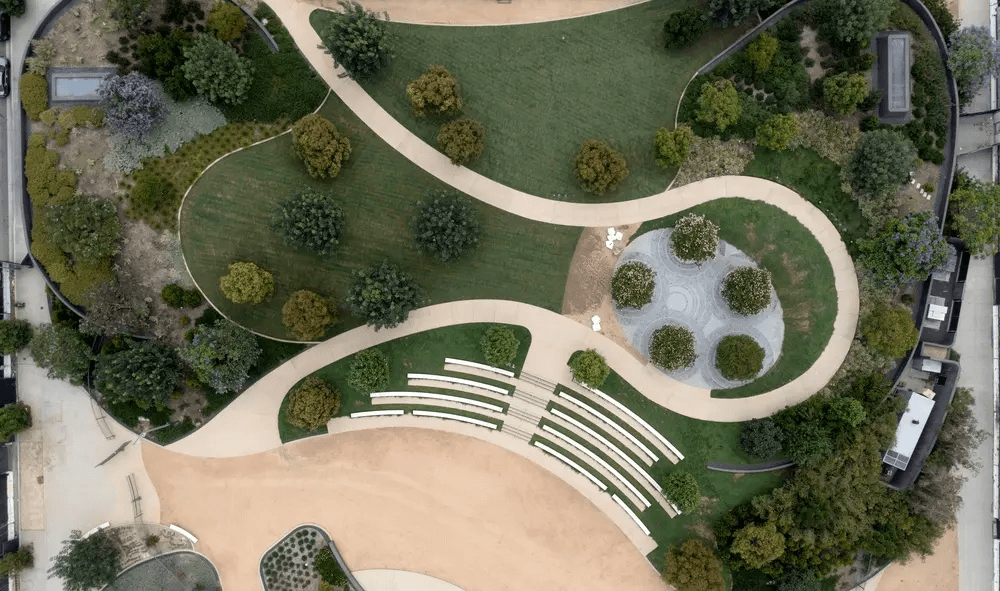
The more than 52,000 square metres of parkland and gardens surrounding the Lucas Museum were designed by landscape architect Mia Lehrer and Studio-MLA. A site that was previously dominated by asphalt parking has been transformed through native and drought-tolerant planting, more than 300 newly planted trees, meadows, a hanging garden, an amphitheatre and a water feature reminiscent of a cascading stream.
The contours of the landscape draw inspiration from California’s hills, valleys, plains and canyons. As a result, the museum does not read as a sculptural object placed onto the park, but rather as something emerging from a newly created terrain.
Ten large-scale sculptures installed throughout the campus extend the museum’s artistic programme outdoors. Importantly, the park will remain accessible to the public without a museum ticket.
This transformation reveals one of the Lucas Museum’s most compelling dimensions. It is not simply adding another striking building to Los Angeles; it is converting space once dedicated primarily to cars into a new part of the city shaped around shade, art and public life.
Courtesy Lucas Museum Of Narrative Art
A New Cultural Destination for Los Angeles
With two theatres offering continuous screenings, a free research library, exhibition spaces and a restaurant named Skywalker Grill, the Lucas Museum has been conceived as something broader than a traditional institution visited for a few hours before moving on. It functions instead as a cultural campus.
Yet even before its opening, perhaps the most intriguing aspect of the project is how it attempts, on an architectural scale, something similar to what George Lucas achieved through cinema: taking familiar elements and dissolving the boundaries between them.
Art and popular culture, museum and park, architecture and landscape all overlap here. When the Lucas Museum of Narrative Art opens on September 22, 2026, it will introduce Los Angeles not merely to another museum, but to a new way of experiencing stories through space.
Courtesy Lucas Museum Of Narrative Art. Photo by Hufton Crow
Saatolog Yıllık Saat Dergisi Saatolog’un yeni sayısı, 2020’nin yarattığı bu dönüştürücü etkiden ilham alarak hazırlandı. Dünya dijitalin etkisiyle her zamankinden de hızlı bir şekilde ilerlerken yavaşlamanın da önemini sonunda kavramış bulunuyoruz ve bu tezatlık hayatlarımızın her anına etki ediyor. Biz de bundan yola çıkarak Saatolog 2020/21 sayısını ‘‘hızlı ve yavaş’’ teması altında hazırladık.