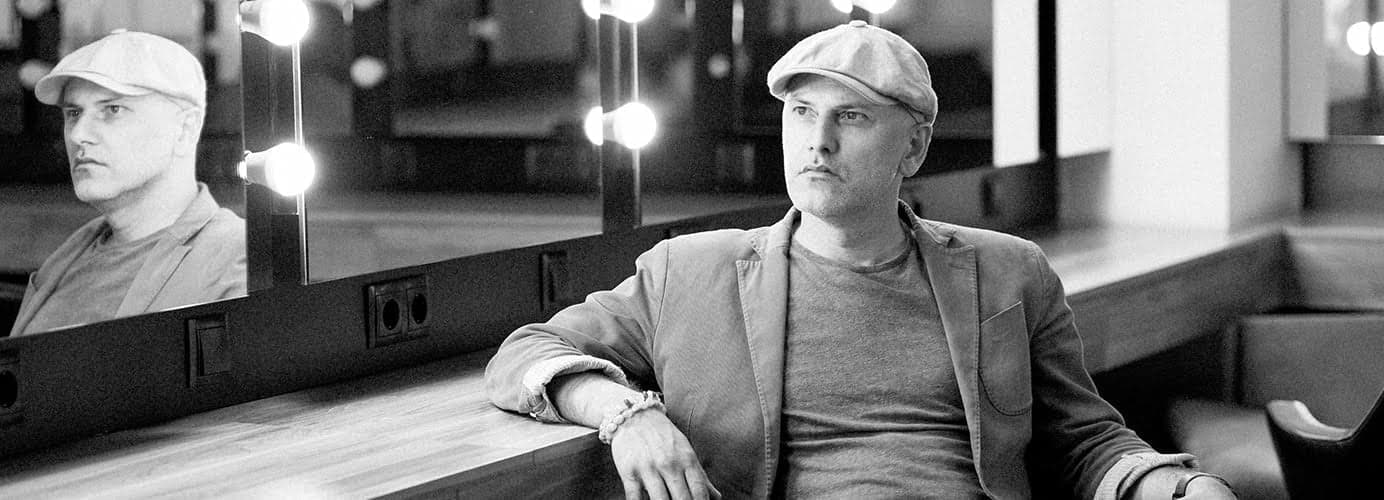
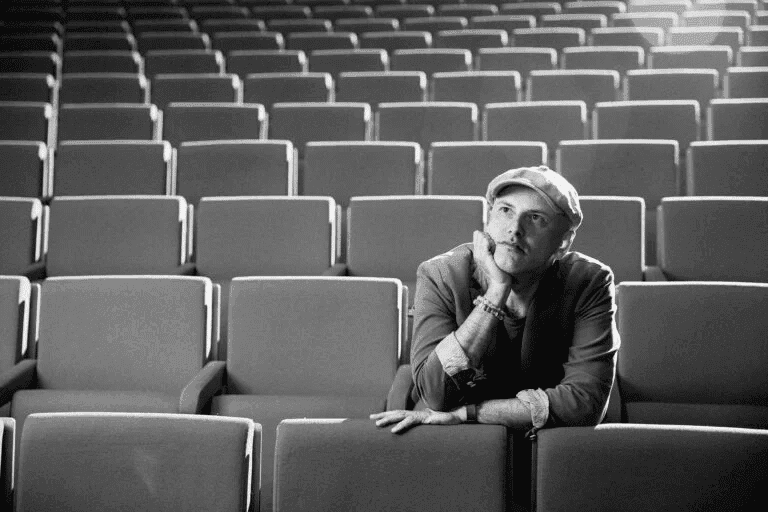
We talked to Serdar Biliş about his new play “The Time Regulation Institute”.
Ahmet Hamdi Tanpınar’s cult novel, The Time Regulation Institute, was brought to theater stage under the direction of Serdar Biliş. In the single-player game, in which Serkan Keskin gives life to Hayri İrdal, Keskin also plays the other characters in the novel. With a window opening from Hayri İrdal’s mind to the past, the audience embarks on a journey through Tanpınar’s poetic language to the years when a society between two civilizations was transformed. We met with Serdar Biliş before the play and talked about the journey of the “The Time Regulation Institute”.
Photos by Serkan Eldeleklioğlu
How did you cross paths with theatre?
Indeed, our paths with the theater crossed many years ago. I went to London to study theater and lived there for a long time. After 2010, I started commuting to Istanbul. I have been working in Istanbul, London and Italy for a while.
“We created a theatrical language in which all the characters in the novel blend into Hayri İrdal’s body and voice, and where one person confronts all the characters.”
How did the idea to adapt the novel for the stage come about?
It was a project I always wanted; The Time Regulation Institute is a novel that I love very much. The character of Hayri İrdal, who scrutinized the changing social movements and time around him with his ability to observe and established a sweet and satirical relationship with his reader, caught my attention. I thought that İrdal could establish a relationship with the audience on stage. While adapting it, I tried to shape Tanpınar’s language without interfering too much. Everything seems to flow in the play as Hayri İrdal remembers his life like a film strip. He remembers the past, replays it in his mind. All the past, all the personalities that created it exist again in his mind, body and voice. We have created a stage language in which all the characters in the novel blend into Hayri İrdal’s body and voice, and where one person confronts all the personalities.
I started work before the pandemic, but it was postponed when the epidemic intervened. However, with this postponement, I had the opportunity to become very familiar with the novel. I stayed in the world of the novel for too long, infused and learned its language. Knowing the novel well, loving it, being connected with love is very effective when brewing and filtering it. Gradually, passing through the sieve, the game found itself. I thought the skeleton had to be the journey where Hayri İrdal turned into a kind of Halit Ayarcı and the tides he experienced. Hayri İrdal’s life, which has hit rock bottom, transforms very quickly after meeting Halit Ayarcı, whom he sees as his benefactor. I tried to give this transformation on the basis of the transformation in society. It’s a very voluminous novel, of course, while preparing the text, some characters and some scenes say, “It’s okay if it’s not me!” he threw himself from the plane.
How did the time pass while adapting the novel into a play?
Preparing the play progressed very slowly, pandemic and earthquake intervened. There is a scene in the book: When Nuri Efendi takes a watch to repair it, he warns the person who brings it not to ask when it will end, because when the watch is finished, it will show itself. The play was like that, he set the time when it was over. As it says in the book, the mine did not accept the setting.
How did Serkan Keskin get involved in the project?
We had already met Serkan. It was the first name that came to my mind when I decided to make the play. I thought that Serkan was very suitable for Hayri İrdal’s character. He had to be ingenious, someone who could move from one character to another. And at the same time, someone who can tell all these transitions through Hayri’s prism.
Can you tell us about working with Mr. Serkan?
Serkan is a very talented actor who drags the audience after him. However, making a single player game was not something that Serkan and I were used to. Since he played all the characters himself, there was no one in front of him at the rehearsal. In the scenes we shot for the play, he played alone in the studio for two weeks, looking at the blue walls, it was hard work.
We see the past and other characters from Hayri İrdal’s mind on the big screen in the middle of the stage. What does this round screen symbolize?
This screen was inspired by the watch and influenced by the cyclical structure of the novel itself. We see the past on this silver screen, which reflects the inside of Hayri İrdal’s mind. We wanted this rail system in the middle of the stage to be a system that works like a Swiss watch and does not wear down, even if it sometimes breaks down like the clocks in Nuri Efendi’s hand. And poetic, of course. Some people liken this decoration to an eye, while others liken it to a clock. I like the audience to name things like that. Ultimately, a screen that reflects the inside of Hayri İrdal’s head.
It’s a play with a very high tempo, Serkan Keskin disguises himself for consecutive scenes and continues in sync with the scene we see on the screen. Did time affect the game?
We really had time in our lives, we focused entirely on timing on the set. In a novel about time, we found ourselves chasing time.
As an Ahmet Hamdi Tanpınar text, dreams also show themselves in the The Time Regulation Institute. How do dreams manifest themselves in the game?
I like everything to be dreamy. At the very beginning of the novel, the sentence “The night that stirs blue inside people like a dream fish” gives this dream air at the very beginning. We tried to extend this dreamlike quality to the whole game. If the play had been adapted more dramatically, it could have even started with Doctor Ramiz with psychoanalysis scenes. There is a letter that Ahmet Hamdi Tanpınar did not include in the serials of the novel. According to what he wrote there, everything takes place in forensic medicine and Hayri İrdal is a mental patient. He doesn’t put the letter in serials, I’m glad he didn’t. While we staged the play, we went through this idea a little bit. It is as if all the events took place in Hayri İrdal’s mind. That’s why the Doctor Ramiz’s part is very precious to me, it is one of the hinges of the work. And of course, with a very modern side, many of us go to therapy today. For example, the whole hall laughs at the line “Almost everyone has been a little sick since psychoanalysis came out”. In adapting these parts, we did not visualize dreams, it remained language. We wanted the images to come to life in the minds of the audience, for example, we included the following sentence: “I sometimes see my father as a pitch-black ship that comes at me while I was churning in a tiny boat.” I wanted to add a dreamlike atmosphere to the whole play.
The game was loved by many people, we heard words of praise from Orhan Pamuk. How did you feel when you watched it for the first time?
The first evening flowed slowly for me, of course I was very excited. It was not a very tried form, we felt that we were doing a special job with the comments received. I said, I’m glad we got into this business as Saatler Kolektif. For example, I am very curious about how the play, which will continue with a brew, will be when it takes the stage next year.
Which was your favorite character in the play?
I love Abdüsselam Bey very much, the sadness in his being alone in that mansion affects me. Abdüsselam Bey’s melancholy, his room, which he sometimes used as a children’s room, where all departures took place, also affected me in the novel. I think, I’m more in love with the sad side of the novel. Among the funniest ones, I like Derviş. With his strange gait, he became a character that made himself in the game.
“Reading the novel constantly so you don’t miss anything is healing. While adapting the novel, I had criteria such as whether I could construct a Tanpınar sentence where I stood or could I think in the consistency of the novel. From time to time, I questioned whether I could like “Tanpınar”.”
How does it feel to carry Tanpınar to the stage?
A feeling that nourishes and heals. It is healing to read constantly in order not to miss anything in the novel. While adapting the novel, I had criteria such as whether I could construct a Tanpınar sentence where I stood or could I think in the consistency of the novel. From time to time, I questioned whether I could think in “Tanpınar”.
What does it mean to think like “Tanpınar”?
He has a deep feeling. Tanpınar’s words are infiltrating your life. Over time, you catch him speaking with his sentence structure.
“Theatre is as pure and deep as telling a story to my son. We did something like “Institute for Making up Stories.”
So, who do you read?
I like to read short stories. For example, we worked with Mahir Ünsal Eriş, Yalçın Tosun and Melisa Kesmez. I like to read Barış Bıçakçı.
What does theater mean to you?
Theater is something as pure and deep as telling a story to my son. That we did something like the “Institute for Making up Stories.”
The Time Regulation Institute has many phrases about time. How would you describe time?
Transformation. In a workshop I recently gave an assignment about looking: Take a long look at something and notice the transformation as you look. For me, time represents that transformation, but realizing time is definitely about looking. Recall that Tanpınar said, “I am neither in time / nor completely out of time”. It is really to be in touch with the moment while chasing that monolithic time, to feel that transformation while looking around.
You are one of the part of Saatler Kolektif, which is a new artist initiative. Can you talk about Saatler Kolektif?
Saatler Kolektif is an artist initiative. It is a structure established by artists with a collective spirit by taking their own initiative. As Halit Ayarcı at The Time Regulation Institute said, “I need people who believe in me,” it became a collective where everyone came together in faith. I think it is very important that the game is made with a collective spirit. The collective structure is not very common in theaters of this scale. As Saatler Kolektif, we have shown that such a work can emerge with an artist collective.
The Time Regulation Institute consists of four parts, we see these titles in the game as well. What do these titles mean to you?

“Great Hopes”:
Great Expectations by Charles Dickens.

“Little Truths”:
The little people we see on the street every day, as close as our next-door neighbors. Just like Hayri İrdal. Hayri İrdal is also a person with a life and small truths that can fill a small walnut shell.

"Toward Morning":
As in the "A Midsummer Night’s" dream, they achieve incredible success at The Time Regulation Institute. “Towards the Morning” evokes the time when one wakes up from that beautiful dream and goes towards the morning, when the day will now light.

“Every Season Has an End”:
A kind of departure. It’s like turning off the lights of the amusement park.
Saatolog Yıllık Saat Dergisi Saatolog’un yeni sayısı, 2020’nin yarattığı bu dönüştürücü etkiden ilham alarak hazırlandı. Dünya dijitalin etkisiyle her zamankinden de hızlı bir şekilde ilerlerken yavaşlamanın da önemini sonunda kavramış bulunuyoruz ve bu tezatlık hayatlarımızın her anına etki ediyor. Biz de bundan yola çıkarak Saatolog 2020/21 sayısını ‘‘hızlı ve yavaş’’ teması altında hazırladık.