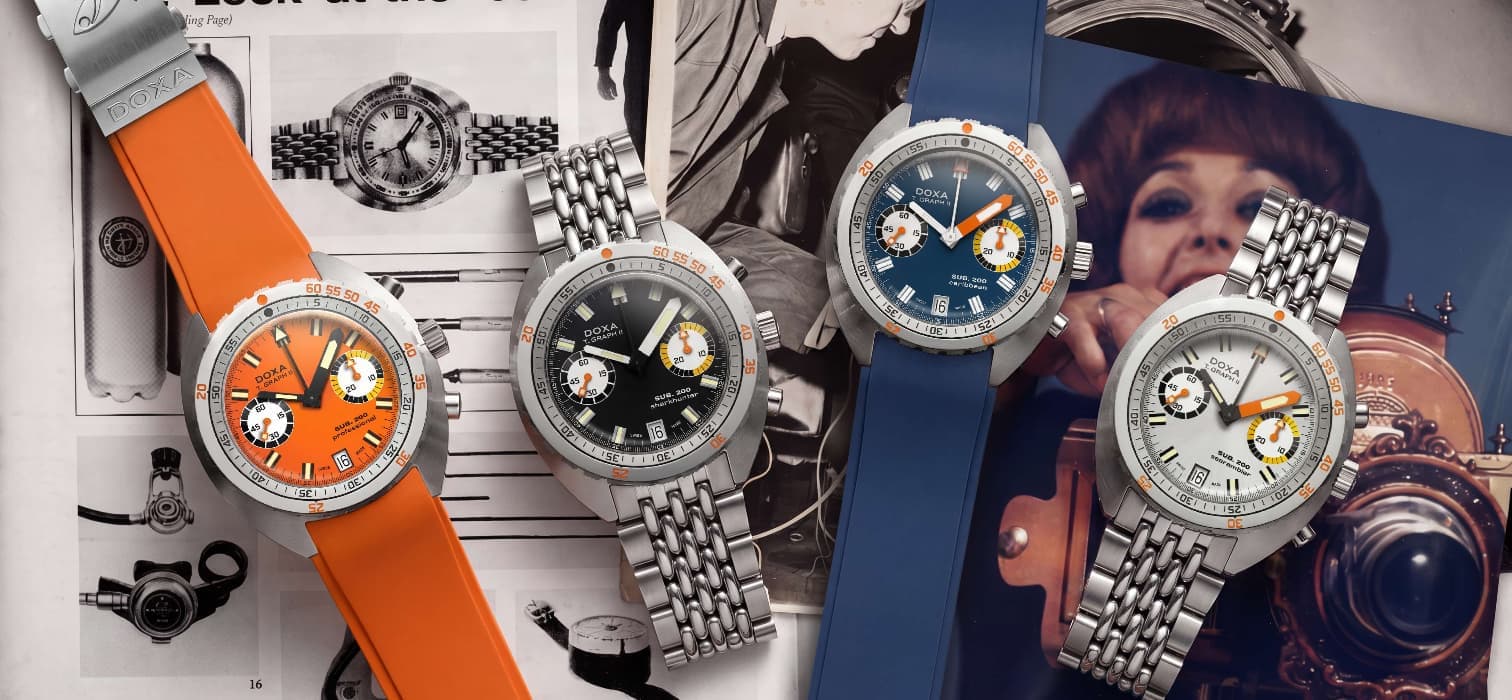
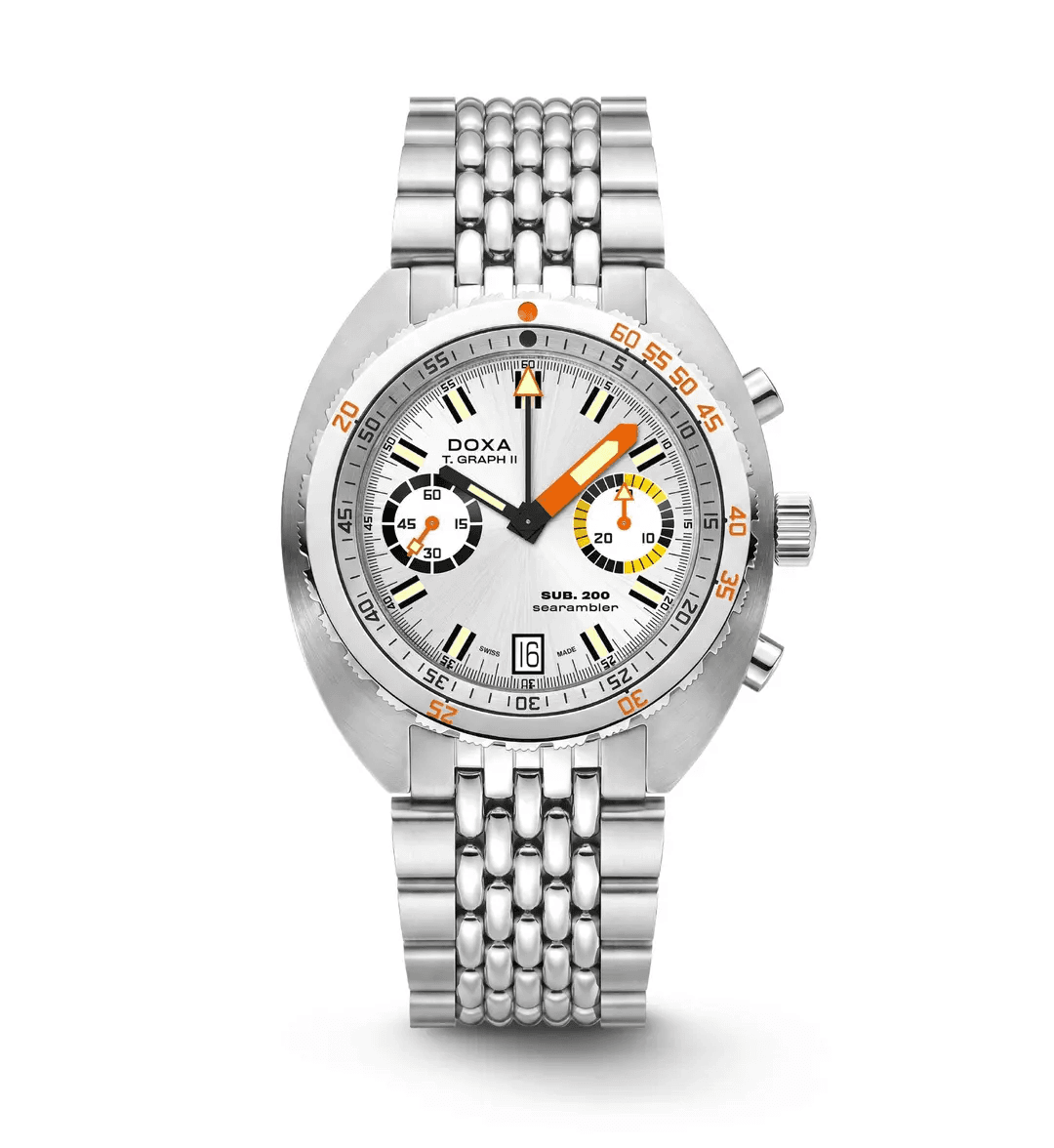
The SUB 200 T.GRAPH II returns in a range of new dial colors. Like every Doxa timepiece, it is adventurous, robust, and undeniably handsome.
What do you find most captivating about watchmaking? Every enthusiast is likely to have a different answer. For some, it is the flawless rhythm of a mechanical movement beating like a heart; for others, it is the story concealed beneath the dial. If you ask us, however, what watch lovers enjoy most is uncovering those hidden stories. They transport us beyond the rush of everyday life, setting sail for distant places and remarkable adventures.
Today, let us follow another such story together. Doxa’s iconic orange dial invites us on a journey back to the late nineteenth century, to the foothills of the Jura Mountains.
When the young watchmaker Georges Ducommun opened the doors of his workshop under the name “Georges Ducommun, Fabriques DOXA,” he was just 21 years old.
The story of Doxa begins in Le Locle, where the young watchmaker Georges Ducommun embarked on his horological career. In 1889, he established a modest workshop and named his company Doxa, derived from the Greek word for “glory” or “splendor.”
It did not take long for the ambitious craftsman’s workshop to evolve into one of the most talked-about Swiss watch manufacturers of the early twentieth century. In 1905, a Doxa pocket watch received the prestigious Exposition Universelle et Internationaleaward at an exhibition in Belgium. The following year, another Doxa timepiece, distinguished by its anti-magnetic properties, was awarded a gold medal at an exhibition in Italy.
The successes continued. In 1907, the brand introduced a calibre offering an impressive eight-day power reserve. This movement would go on to equip the dashboards of Bugatti racing cars for many years, further cementing Doxa’s growing reputation for technical excellence.
Born into a family with thirteen children, Georges Ducommun laid the foundations of what would become one of Switzerland’s most respected watchmakers through determination and extraordinary perseverance. By the time of his passing in 1936, Doxa had accumulated an impressive list of achievements. Leadership of the company passed to his son-in-law, Jacques Nardin, the grandson of Ulysse Nardin.
Under Jacques Nardin’s direction, Doxa continued expanding its sports watch portfolio while introducing innovative creations including alarm watches and ring watches. During the 1950s, the Bauhaus-inspired, square-cased Grafic collection brought a fresh aesthetic to the brand’s catalogue. Doxa was steadily strengthening its place within Swiss watchmaking, creating models destined to leave a lasting mark on horological history.
The birth of an icon, the orange dial, was just around the corner.
The Birth of the Orange Dial: The SUB Legend
Fast-forward to the early 1960s. Our destination is beneath the surface of Lake Neuchâtel.
Working alongside professional diver Claude Wesly, Doxa tested a new diving watch in the lake’s deep waters. The vivid orange dial proved exceptionally legible underwater, outperforming conventional dial colors in low-visibility conditions.
Following extensive testing, the watch made its official debut at Baselworld in 1967 as the SUB 300. With its striking orange dial, patented rotating bezel, and cushion-shaped monobloc stainless steel case, the SUB 300 immediately established itself as something entirely new. It also found a celebrated companion: Jacques-Yves Cousteau.
During the development of the SUB 300, Doxa collaborated closely with the legendary diver and oceanographer Jacques-Yves Cousteau. His expertise played an important role in refining the watch’s technical capabilities, while the orange dial gradually became a cultural icon in its own right. Cousteau wore Doxa SUB watches throughout his underwater expeditions and documentary films.
Jacques-Yves Cousteau
Their partnership ultimately evolved beyond technical collaboration. Cousteau became Doxa’s exclusive distributor for North America.
By the 1970s, the SUB 300 had gained another notable companion. Author Clive Cussler placed the SUB 300T on the wrist of his legendary protagonist Dirk Pitt. Through Pitt’s adventures, Doxa’s diving watches became firmly embedded in the imagination of an entire generation of readers.
Following decades of change, the company underwent restructuring during the 1990s. In 1997, ownership passed to the Jenny family, ushering in a new chapter that honoured the brand’s distinguished heritage while reaffirming its position within Swiss watchmaking. The orange dials continued measuring time beneath the waves, while the SUB collection steadily expanded with new references and contemporary refinements.
Yet despite these evolutions, the adventurous spirit embodied by Dirk Pitt, and the unmistakable orange dial, never disappeared. Every Doxa watch continues to carry forward the determination of founder Georges Ducommun and the pioneering spirit of those who helped shape the brand, faithfully keeping time in the deepest waters.
A New SUB 200 T.GRAPH II Inspired by 1969
Earlier this summer, Doxa introduced a new addition to its collection, inspired by a model first designed in 1969: the SUB 200 T.GRAPH II.
The original SUB 200 T.GRAPH, launched in 1969, was a diving chronograph, an uncommon concept for its era. It combined a professional dive bezel for underwater use with a chronograph complication for everyday timing on land.
Nearly six decades later, that original concept has been revived through the introduction of the new SUB 200 T.GRAPH II collection, available in eight references.
The new SUB 200 T.GRAPH II features a stainless steel case measuring a more compact 42 mm × 44.5 mm compared to the original model. At 14.6 mm thick, the case offers water resistance to 200 metres. The screw-down crown is flanked by chronograph pushers positioned on either side.
The collection comprises eight references, offering an equally diverse selection of dial colors. Blue, black, orange and silver dials are available. The bicompax chronograph layout features a 30-minute chronograph counter at 3 o’clock, a running seconds display at 9 o’clock, and a date aperture positioned at 6 o’clock. Across the entire collection, the minute scale on the bezel is highlighted in Doxa’s signature orange.
No Doxa would be complete without one of the brand’s signature design elements: the stainless steel beads-of-rice bracelet. Matching rubber straps coordinated with each dial colour are also available, allowing this capable adventure companion to adapt effortlessly to different styles and occasions.
Powering the SUB 200 T.GRAPH II is the Sellita SW510 calibre, offering a power reserve of approximately 56 hours.
Having taken us on a journey through more than a century of watchmaking history, the story returns to the present day. A rich heritage continues to inspire new dials and new generations of wristwatches. Doxa’s legendary orange dial still accompanies divers beneath the surface, maintaining exceptional legibility in the blue depths. The tides may rise and fall, but time remains as unmistakably clear on a Doxa dial as ever. And when your adventures return to dry land, the SUB 200 T.GRAPH II stands ready, with its chronograph complication, to accompany whatever comes next.
For more information about the new SUB 200 T.GRAPH II collection, please visit Doxa’s official website.
Saatolog Yıllık Saat Dergisi Saatolog’un yeni sayısı, 2020’nin yarattığı bu dönüştürücü etkiden ilham alarak hazırlandı. Dünya dijitalin etkisiyle her zamankinden de hızlı bir şekilde ilerlerken yavaşlamanın da önemini sonunda kavramış bulunuyoruz ve bu tezatlık hayatlarımızın her anına etki ediyor. Biz de bundan yola çıkarak Saatolog 2020/21 sayısını ‘‘hızlı ve yavaş’’ teması altında hazırladık.